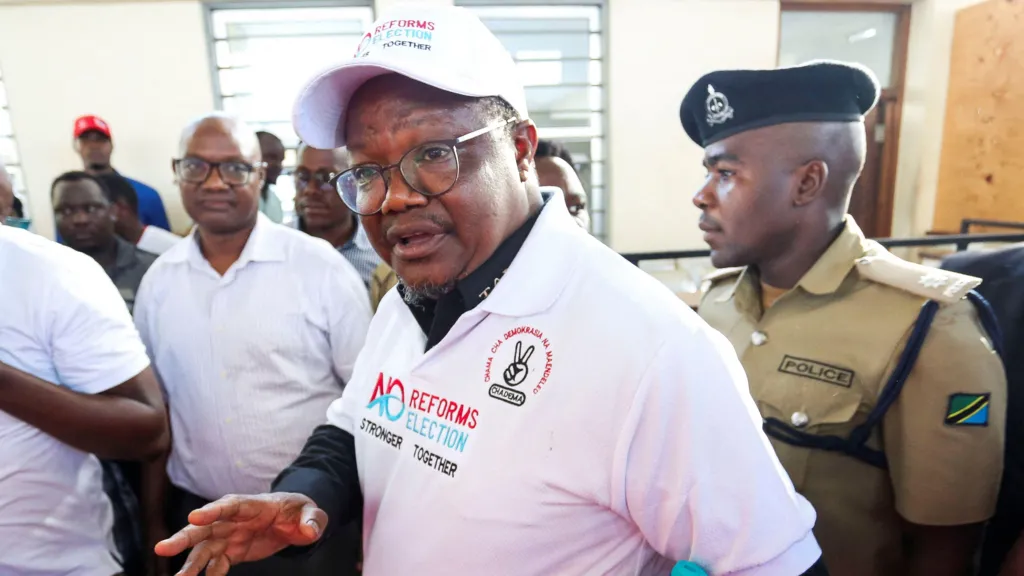
Polling stations across Tanzania’s largest city, Dar es Salaam, saw low voter turnout on Wednesday amid a heavy security presence and the absence of key opposition challengers to President Samia Suluhu Hassan.
The government and police had warned that protests would not be tolerated, deploying tanks and armed officers throughout the city to deter unrest.
However, the heightened security appeared to discourage many voters from turning out.
AFP journalists reported that several polling stations in typically busy areas were nearly empty an hour after opening an unusual sight compared to previous elections.
“We are mobilising people from the streets and their homes to come and vote,” an official from the ruling Chama Cha Mapinduzi (CCM) party in Dar es Salaam’s Temeke district told AFP on condition of anonymity. “We need to rescue the situation because some are hesitating.”
A 40-year-old food vendor, identified only as Saada, said she was too frightened to vote. “I could not go out today because of fear of violence,” she told AFP.
Amnesty International has condemned what it calls a “wave of terror” in the run-up to the vote, citing “enforced disappearances, torture, and extrajudicial killings of opposition figures and activists.”
President Hassan, 65, is seeking to secure a decisive victory to consolidate her authority within the ruling party, according to analysts. Her main rival, Tundu Lissu of the opposition party Chadema, is currently on trial for treason and faces a possible death sentence. Chadema has been barred from participating in the election.
The only other significant challenger, Luhaga Mpina of ACT-Wazalendo, was disqualified on technical grounds, leaving Hassan with little serious competition.
Hassan, who became Tanzania’s first female president in 2021 following the death of her predecessor John Magufuli, initially won praise for loosening restrictions on the opposition and media. However, rights groups say those reforms have since been reversed.
Human Rights Watch has accused the government of suppressing political dissent, muzzling the press, and failing to ensure the independence of the electoral commission.
Concerns are also growing that even ruling party members are being targeted.
Humphrey Polepole, a former CCM spokesperson and ambassador to Cuba, went missing earlier this month after resigning and publicly criticising President Hassan. His family later discovered bloodstains at his home.
The Tanganyika Law Society reports at least 83 confirmed abductions since Hassan took office, with 20 more cases recorded in recent weeks.
Polling also took place in Zanzibar, where analysts predict a more competitive race due to relatively greater political freedom. However, most foreign journalists have been denied access to the mainland, limiting independent observation of the vote.
An analyst in Dar es Salaam, speaking anonymously, said President Hassan has not dismantled the intelligence network built by Magufuli. “They are laser-focused on any sign of internal dissent and throttled the opposition ahead of the last election in 2020,” the analyst said. “We thought Magufuli was a blip and the 2020 elections were an abnormality. My worry is that this is the new normal.”
Despite political tensions, protests remain rare in Tanzania, partly due to a steady economy that grew by 5.5 percent last year, driven by strong agriculture, tourism, and mining sectors.
President Hassan has pledged major infrastructure projects and universal health insurance to appeal to voters. Over the weekend, police arrested 17 people in Kagera region on allegations of planning election-day unrest.
“I want to assure citizens that there will be no security threat on voting day,” Hassan said at a recent campaign rally. “We are well-prepared for security. Those who have failed to participate in the competition should not seek to disrupt our election.”
Cooking Gas Prices in Kenya Climb to 10-Month Peak Despite Scrapping of VAT and Other Levies