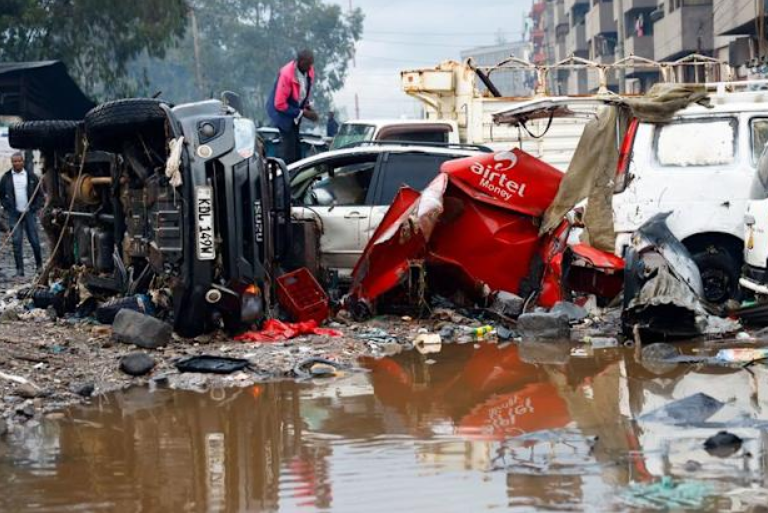
Nairobi Governor Johnson Sakaja Monday announced a series of emergency measures after devastating floods in Nairobi claimed 33 lives and displaced more than 2,000 residents.
Speaking on Monday after chairing the second sitting of the Joint Implementation Committee on the Cooperation Agreement between the National Government and Nairobi City County Government at City Hall, the governor expressed condolences to families affected by the disaster.
Sakaja said the county government was working with multiple national agencies to respond to the crisis and prevent further loss of life.
“Behind these numbers are families grieving loved ones, children forced from their homes, and communities struggling to recover,” he said.
Agencies tasked with flood response
The meeting brought together senior officials from key national agencies including the Kenya Urban Roads Authority (KURA), Kenya National Highways Authority (KeNHA), Kenya Rural Roads Authority (KeRRA), National Environment Management Authority (NEMA), the Water Resources Authority and the National Treasury.
Sakaja said the agencies have been directed to submit a comprehensive joint assessment and costed action plan within 48 hours to address damage caused by heavy rains to roads, drainage systems and other critical infrastructure.
The committee also ordered a citywide assessment to identify and map flood-prone areas and drainage bottlenecks across Nairobi’s 17 sub-counties.
The report will prioritize immediate desilting of drainage systems and repair of damaged roads, while also reviewing the city’s stormwater drainage system and recommending long-term improvements.
Authorities also directed a multi-agency team to intensify the recovery of riparian and floodplain areas along major river corridors under the coordination of the Nairobi Rivers Commission.
The move aims to restore natural river flow and reduce the risk of future flooding.
Water supply restored in several estates
Sakaja confirmed that a major water transmission pipeline along Outer Ring Road that had been damaged by floods has now been repaired.
Water supply has been restored to several estates including Buruburu Phases 1 and 2, Kariobangi North and South, Dandora and parts of Mathare.
Repair works are ongoing in Kiambiu and Korogocho.
The county government has also deployed public health and environmental teams to prevent disease outbreaks following the floods.
According to the governor more than 300 households and sanitation facilities have been disinfected, water quality testing and chlorination of contaminated sources have been conducted and over 4,000 household water treatment supplies have been distributed.
More than 30 flood-affected schools, serving about 3,800 students, have been disinfected.
Additionally, environmental health officers and community health promoters have reached over 1,300 residents with hygiene and water safety education.
Sakaja said technical teams from both the national and county governments are working round the clock to prepare an implementation matrix and cost estimates to support recovery efforts.
The committee is expected to reconvene on March 19, 2026 to review progress.
“The cooperation between the National Government and Nairobi City County Government is already yielding results, and we will continue working together to protect lives, restore infrastructure, and build a more resilient Nairobi,” Sakaja said.
READ ALSO;
Doctors Defend Appeal To President Over Alleged Crisis At Nairobi Hospital
