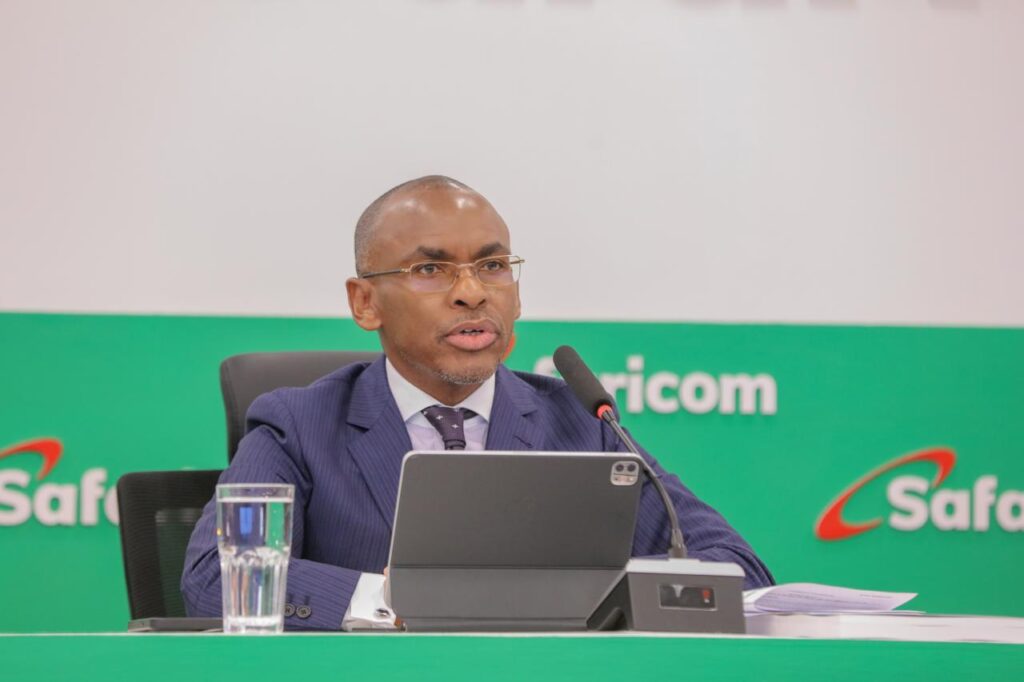
Safaricom is set to release its full-year results for the period ending 31 March 2026 this week, with analysts forecasting its most robust earnings performance in at least five years, driven by improving fortunes in Ethiopia and sustained strength in its Kenyan operations.
A survey of analysts and brokerage firms, alongside consensus data from S&P Global Market Intelligence, projects net income attributable to shareholders in the range of KSh 82.0 billion to KSh 95.8 billion, a marked rise from KSh 69.8 billion recorded in FY25. The average estimate stands at KSh 86.1 billion, suggesting year-on-year growth of roughly 23 percent.
Notably, all analysts surveyed expect the company to increase its dividend, which would mark its first upward adjustment since FY22.
Revenue outlook: Kenya stable, Ethiopia decisive
Total revenue is projected at around KSh 423.9 billion, representing a 9 percent increase from FY25’s KSh 388.7 billion. While this signals a slight slowdown from last year’s 11.2 percent growth, it still comfortably outpaces inflation. Forecasts vary widely, ranging between KSh 415.0 billion and KSh 440.0 billion, largely due to differing expectations around the Ethiopian market.
For instance, Standard Investment Bank offers the most optimistic revenue projection at KSh 440.0 billion, anticipating faster growth in Ethiopia, while Sterling Investment Bank takes a more conservative stance at KSh 417.6 billion. Estimates for Kenya’s core business, however, remain largely consistent across analysts.
Revenue from M-Pesa is expected to reach KSh 190.4 billion, reflecting an 18.2 percent increase from KSh 161.1 billion in FY25. This would extend its streak of double-digit growth since FY20, with the platform now contributing over 41 percent of total group revenue, a share analysts expect to edge even higher.
Margins: the key point of contention
Analysts are most divided on profitability margins, particularly EBITDA. Estimates range from 45.4 percent to 51.1 percent, a sizeable gap. The upper end, reflected in institutional consensus data from S&P Global, suggests a near-complete recovery from margin pressures linked to Safaricom’s Ethiopia expansion.
However, this view appears optimistic, given that company guidance points to Ethiopia reaching EBITDA breakeven only in FY27. A more balanced expectation centres around a 49.2 percent margin, implying a moderate recovery rather than a full rebound.
Also Read: U.S. Grain Shipment Launches Agricultural Innovation Program In Kenya
Operating profit (EBIT) is forecast at KSh 146.8 billion, which would set a new record, surpassing the FY22 peak of KSh 109.1 billion by a significant margin. This reflects both revenue growth and easing depreciation and amortisation pressures as capital expenditure in Ethiopia stabilises.
Dividend rebound on the cards
Dividend projections range between KSh 1.50 and KSh 1.84 per share, compared to the unchanged KSh 1.20 paid over the past three years. With free cash flow rebounding to KSh 63.1 billion in FY25 from a low of KSh 10.3 billion in FY24, analysts believe the company is well-positioned to reward shareholders.
A payout near the consensus estimate of KSh 1.69 per share would represent a 41 percent increase, bringing the payout ratio back towards its historical range of 75 to 80 percent.
Earnings per share are expected to average KSh 2.14, the highest level since at least FY21, marking a clear break from the relatively flat performance seen over the past four years.
Safaricom is expected to announce its results on Thursday, May 7, 2026, in what is shaping up to be a closely watched release for investors tracking the company’s next phase of growth.