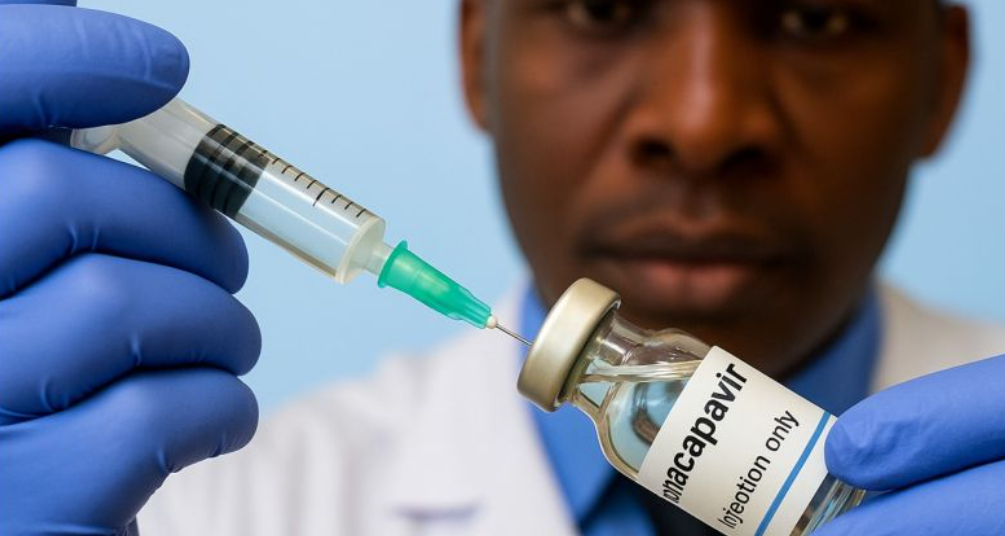
Doctors Without Borders/Médecins Sans Frontières (MSF) launched a campaign today demanding that the US-based pharmaceutical corporation Gilead Sciences immediately make the highly effective HIV prevention medicine lenacapavir more widely available across the globe.
MSF is also demanding that governments use all available legal tools to challenge Gilead’s monopoly so other manufacturers can help boost the global supply and further reduce prices.
Gilead, which controls the production and distribution of this game-changing medicine, currently sells it at very high prices to a very limited set of countries, has severely restricted supply to low- and middle-income countries (LMICs), and refuses to sell it directly to MSF.
Lenacapavir is a long-acting injectable form of pre-exposure prophylaxis (PrEP) administered just twice a year that is nearly 100 percent effective in preventing someone from acquiring HIV.
It is especially valuable for people at heightened risk, including gay men and other men who have sex with men, transgender individuals, people who use injectable drugs, and sex workers.
It is also a critical tool for people on the move, people living in remote areas with few health care options, and people caught in humanitarian emergencies. About 1.2 million people worldwide acquired HIV in 2025.
“Millions of people need lenacapavir right now,” said Dr. Tom Ellman, MSF’s Southern Africa Medical Unit (SAMU) director.
“In the early days of HIV/AIDS, we were left empty-handed in places like South Africa as pharmaceutical corporations sold their antiretrovirals to the highest bidders.
We know how this ended: we saw our patients with HIV die and entire communities devastated.
We can’t let history repeat itself with this transformative prevention medicine.
Gilead and governments must do more to increase access to this medicine for people everywhere.”
Despite repeated requests throughout the past year, Gilead has refused to sell this medicine to MSF for use in its medical programs worldwide — at any price.
The company has instead told MSF to get it from The Global Fund to Fight AIDS, Tuberculosis, and Malaria, which has received a limited number of doses from Gilead for LMICs.
However, those doses are already running short in places like Eswatini and Kenya, and some of the countries and communities that MSF is trying to reach aren’t eligible to receive them.
Meanwhile, lenacapavir is purchasable and heavily marketed in the US, where it is priced at over $28,000 a year per patient.
“Gilead says it wants to end the HIV epidemic ‘for everyone, everywhere,’ but their strategy raises serious doubts,” said Melissa Barber, MSF USA global health advocacy and policy advisor.
“It’s problematic enough that they have excluded countries with rising HIV incidence like Brazil from being able to benefit from generic versions of lenacapavir.
Now, it appears that Gilead is closed for business as they refuse to sell us this medicine for use in southern Africa, Central America, and beyond.
Gilead must do more to ensure people have access to both shots to cover a full year of protection, for no more than $40, everywhere.”
The broader structural problem is Gilead’s restrictive access model, one in which the company controls who can receive lenacapavir, where it can be supplied, and on what terms.
Gilead has made a deal with select generic manufacturers to make the medicine available at a lower price than it sells it for in wealthier countries.
However, these generics will not be available until 2027 at the earliest.
Additionally, many countries — including countries like Argentina, Brazil, Mexico, and Peru — that hosted the lenacapavir clinical trials are excluded from that license altogether.
In fact, a quarter of new HIV infections are happening in countries excluded from the existing licensing arrangements.
Beyond Gilead, governments also have a role to play in making lenacapavir more widely accessible.
If Gilead continues to charge high prices for this medicine and restrict its production, governments should take any and all necessary steps to make it easier to override Gilead’s monopoly on this product.
Governments are afforded a broad range of flexibilities under the World Trade Organization’s agreement on Trade- Related Aspects of Intellectual Property Rights (TRIPS).
For example, countries may grant compulsory licenses on otherwise patented products, allowing them to make use of the subject matter of a patent without the authorization of the patent holder.
Actions like this can remove intellectual property barriers and may facilitate broader generic production.
“Governments must step in if Gilead continues to put profits over people’s health,” Dr. Ellman said.
“There are legal tools in place under the TRIPS agreement to bypass patents that block access to critical medicines like lenacapavir.
It’s time governments start using them to get more people on this critical HIV prevention medicine.”
READ ALSO;
Relief As KWS Relocates Two Elephants From Makueni After Fatal Attacks
