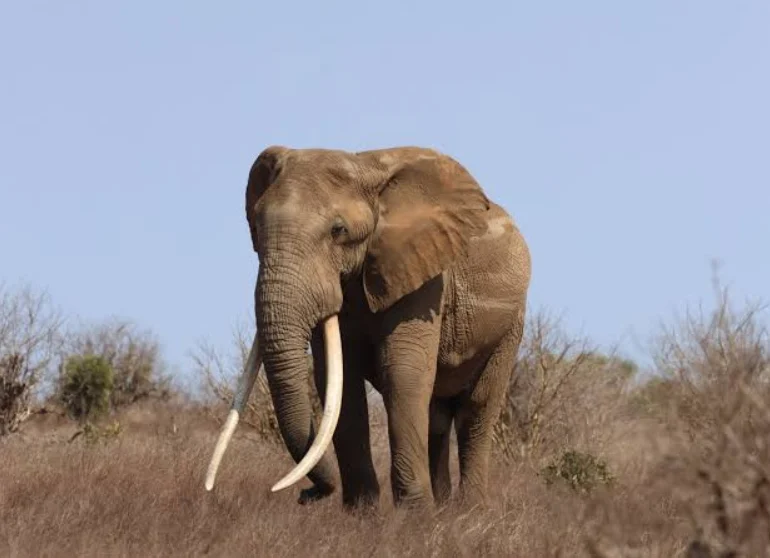
A female elephant was shot dead by a National Police Reservist (NPR) officer after charging at workers removing invasive Opuntia cactus at Lolldaiga Conservancy in Laikipia County.
The incident occurred on Thursday, November 19, at about 6.20 pm, after three elephants reportedly charged towards casual workers engaged in the cactus removal exercise within the conservancy.
According to police and Kenya Wildlife Service officials, the incident was reported by the conservancy’s security, who said NPR officers were providing security to the workers when the elephants charged at them.
An NPR officer reportedly fired 10 blank rounds into the air from a G3 rifle in an attempt to scare the elephants away.
However, one of the female elephants allegedly became more aggressive and charged at the workers, prompting another reservist, Josephat Mamai, to fire five live rounds from his G3 rifle, killing the animal.
Police officers alongside the Kenya Wildlife Service (KWS) Nanyuki investigations team visited the scene, which was processed and documented as investigations and other necessary actions commenced.
The incident comes amid growing human-wildlife conflict in Laikipia, with residents in areas surrounding Lolldaiga Conservancy raising concerns over repeated elephant incursions into farms and settlements.
Earlier this week, two bull elephants were relocated from Lolldaiga Conservancy to Meru National Park following complaints from residents over crop destruction and safety concerns.
In May 2025, Kenya introduced the third phase of its Human–Wildlife Conflict Compensation Programme, an initiative aimed at addressing these incidents and supporting affected families.
During its launch at Meru National Park, President William Ruto unveiled the innovative Wildlife Conservation Card, a new tool designed to help fund conservation efforts.
“Compensation is justice, but prevention is progress,” Ruto said, emphasizing the need for long-term solutions that benefit both people and wildlife.
“Through the Conservation Card, fencing, and community‑led tourism, we are turning conflict into opportunity,” he added.
Developed in partnership with KCB Bank, the Wildlife Conservation Card is available in three tiers—Platinum (Elephant), Gold (Lion), and Silver (Cheetah).
A portion of every transaction made with the card (Sh10, Sh5, and Sh3, respectively) goes directly to the Wildlife Conservation Trust Fund.
The initiative aims to enable Kenyans and international supporters to contribute to wildlife conservation while fostering economic benefits for local communities.
With this new approach, Kenya hopes to build a future where humans and wildlife can coexist more safely and sustainably.

