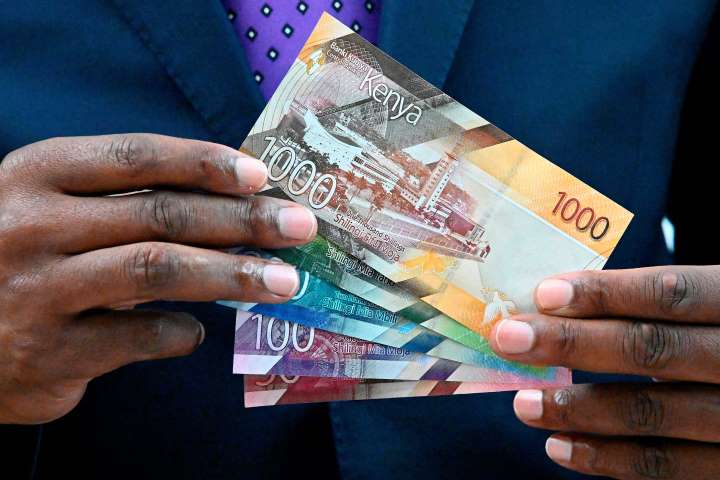
Kenya has overtaken Ethiopia to become Eastern Africa’s largest economy, ending its neighbour’s five-year dominance, according to the International Monetary Fund’s (IMF) October 2026 World Economic Outlook report.
The report shows that Kenya’s gross domestic product (GDP) increased by 13.7% in dollar terms in 2025, reaching $135.92 billion (approximately KSh 17.57 trillion).
During the same period, Ethiopia’s dollar-denominated GDP dropped by nearly 40% to $126.35 billion, leaving Kenya ahead by $9.57 billion.
What Is Kenya’s GDP in October 2026?
By October 2026, Kenya’s GDP had risen further to $151.15 billion, compared with Ethiopia’s $127.15 billion, according to the IMF projections.
The development restored Kenya’s position as the region’s leading economy after Ethiopia held the top spot for five consecutive years.
Kenya also ranked seventh among Africa’s largest economies, while Ethiopia fell to eighth place. The latter’s decline was particularly notable given that its GDP stood at $210 billion in 2024.
How Currency Movements Influenced the Rankings
Despite the change in rankings, Ethiopia recorded stronger real economic growth than Kenya in 2025.
The IMF estimated Ethiopia’s growth at 9.2%, compared with Kenya’s 4.6%. This indicates that currency movements, rather than a contraction in Ethiopia’s underlying economic activity, were the primary factor behind the reversal in dollar-denominated GDP rankings.
Ethiopia’s birr lost more than a third of its value against the US dollar after the government relaxed strict foreign exchange controls in the second half of 2024.
The move was part of reforms linked to a four-year, $3.4 billion IMF financing programme intended to stabilise the economy and address foreign exchange challenges.
Charlie Robertson, chief economic adviser to Equity Group Holdings CEO James Mwangi, observed that Ethiopia’s currency had previously been significantly overvalued.
Also Read: IMF Names 10 Fastest-Growing Economies in Sub-Saharan Africa in 2026
Robertson explained that the currency effect was largely responsible for the shift, noting that the birr had been approximately 50% overvalued two years earlier but was subsequently estimated to be about 20% undervalued.
Kenya also benefited from a recovery in the value of the shilling, which boosted the country’s GDP when measured in US dollars.
Kenya’s Economic Outlook
The IMF projects that Kenya will maintain its position as Eastern Africa’s largest economy in the coming years.
The country could also overtake Angola by 2028, potentially becoming Africa’s sixth-largest economy.
Such a development would further strengthen Kenya’s standing among the continent’s major economic players.
How Do Other East African Economies Compare?
Kenya’s economic output remains considerably larger than that of several neighbouring countries.
According to the report, Kenya’s GDP exceeds that of the Democratic Republic of Congo by approximately $28.87 billion. Its economy is also nearly twice the size of Tanzania’s.
Burundi ranks considerably lower, with an economy approximately 20 times smaller than Kenya’s, highlighting the substantial differences in economic output across the region.