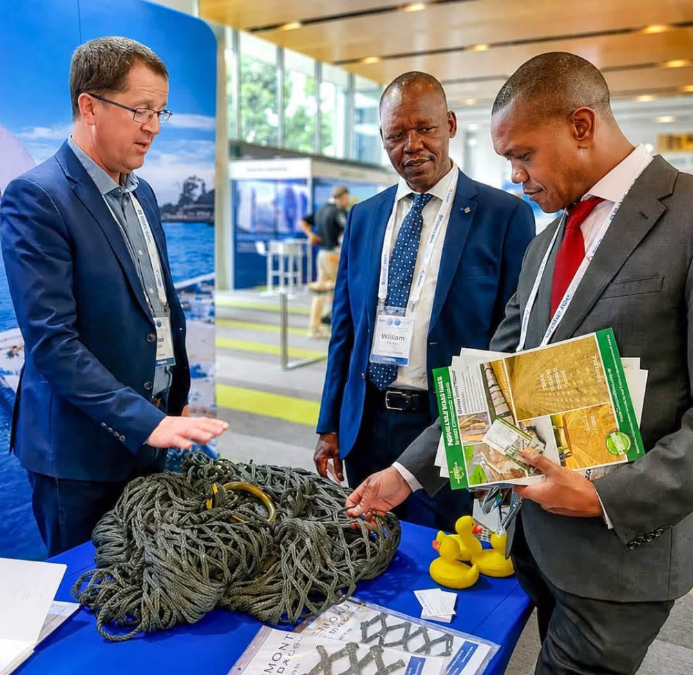
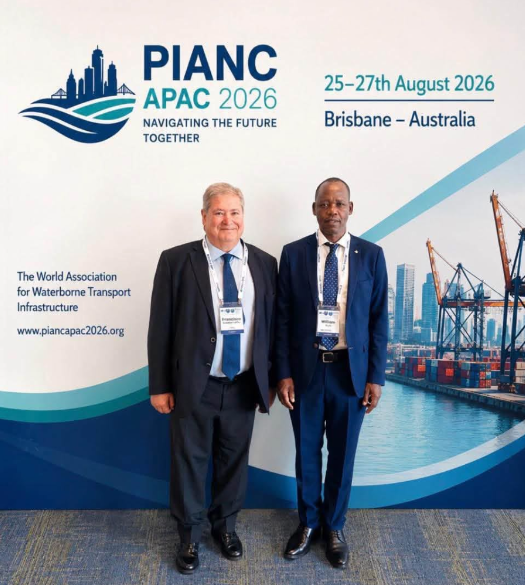
Kenya is positioning its ports at the centre of Africa’s emerging green maritime economy, with Kenya Ports Authority (KPA) Chief Executive Officer Capt. William Ruto leading the country’s delegation at the Permanent International Association of Navigation Congresses (PIANC) conference in Brisbane, Australia.
The conference has brought together shipping, maritime and infrastructure experts to examine how ports can become smarter, cleaner, more resilient and competitive as global trade, technology and environmental expectations evolve.
Capt. Ruto is leading a KPA delegation comprising General Manager, Engineering Services Eng. Julius Tai, General Manager, Corporate Services Edward Kamau and Marketing Manager Miriam Mwakundia.
The Brisbane forum, held under the theme “Connecting and Sharing among Oceania and Asia-Pacific Neighbours,” is focusing on future port capacity, pilotage, mobile power systems, nature-positive infrastructure, resilience, innovation and the use of data in port development.
For Kenya, the discussions come as KPA accelerates the transformation of the Port of Mombasa while advancing Lamu and Shimoni as strategically important maritime facilities.
Green ports are the future
Capt. Ruto is expected to emphasise that sustainability can no longer be treated as an optional addition to port development but as a core requirement for efficiency, competitiveness and long-term economic growth.
“The future of ports will not be measured only by the amount of cargo they handle, but by how intelligently, efficiently and sustainably they handle that cargo. A modern port must create economic value while protecting the environment that sustains our communities.”
He is also expected to highlight the role of technology and partnerships in driving the transition towards cleaner port operations.
“Green ports are smart ports. We must combine innovation, renewable energy, cleaner equipment, data and strong partnerships to build ports that are competitive today and resilient enough to serve generations tomorrow.”
The message is consistent with KPA’s Green Port Policy 2024–2028, which seeks to integrate environmental, social and governance principles into port operations while promoting renewable energy, green technology, emissions reduction and protection of marine and coastal ecosystems.
Mombasa targets greener operations
At the Port of Mombasa, KPA has been implementing initiatives aimed at reducing the environmental footprint of port operations.
They include investment in renewable energy, cleaner cargo-handling technologies, shore-power infrastructure, energy efficiency and environmental conservation.
KPA has been developing a shore-power facility and expanding solar generation while pursuing the adoption of electric and hybrid cargo-handling equipment and exploring wider e-mobility infrastructure.
The Authority has also intensified environmental restoration around Mombasa.
Among its recent initiatives is the planting of 5,000 mangrove seedlings at Mchenjani in Dongo Kundu, part of a wider 20,000-seedling restoration programme linked to the expansion of Berth 19B.
The Port of Mombasa has also welcomed cleaner-generation vessels, including the ammonia-ready Grande Shanghai, underscoring the changing nature of global shipping and the need for ports to prepare for lower-emission vessels and technologies.
KPA’s modern cruise terminal is another example of the Authority’s green infrastructure ambitions, with the facility described as fully solar powered.
Lamu positioned as green gateway
The sustainability agenda also extends to the Port of Lamu, which is being positioned as a strategic deep-water gateway within the LAPSSET Corridor.
KPA has outlined plans to bring Lamu into compliance with its Green Port Policy, ensuring that its development and operations incorporate environmentally responsible practices.
The port currently has three operational berths, each with a 400-metre quay, and is designed to accommodate large Panamax and Post-Panamax vessels.
Its strategic location and deep-water characteristics give Lamu significant potential as a regional maritime and transshipment hub.
For KPA, however, expanding capacity must go hand in hand with resilience, efficiency and environmental responsibility.
“As we expand our maritime infrastructure, we must make sure that every new investment is an investment in resilience. Green infrastructure is not a cost to development; it is an investment in the competitiveness and longevity of our ports.”
Shimoni links Blue Economy to conservation
Further south, KPA’s development of the Shimoni Fish Port represents another component of Kenya’s Blue Economy ambitions.
The modern fishing port is designed to support fish production, processing and value addition. Its facilities include cold storage, reefer stations, an ice-making plant, a bio-digester and wastewater management systems.
The facility is expected to strengthen the fishing industry, reduce post-harvest losses and open new opportunities for local and international markets.
Environmental conservation has also formed part of the wider Shimoni development agenda.
KPA has worked with local communities and other partners on mangrove restoration, including a programme involving the rehabilitation of 500 acres of degraded mangroves near Shimoni.
More than 10,000 mangroves had been planted through the initiative, according to the World Port Sustainability Program.
KPA has also undertaken tree-planting initiatives around Shimoni, including the planting of 2,000 trees in degraded areas.
The Shimoni model demonstrates how port development can be linked to environmental conservation, fisheries, livelihoods and the wider Blue Economy.
Towards a new generation of Kenyan ports
The Brisbane conference provides KPA with an opportunity to benchmark Kenya’s maritime infrastructure against international practices while sharing experiences with port authorities, engineers and maritime specialists from around the world.
PIANC President Francisco Esteban Lefler has similarly stressed the importance of cooperation, knowledge sharing, innovation and talent in responding to emerging challenges in the maritime sector.
For Kenya, the direction is increasingly clear: the next generation of ports must be efficient, digital, resilient and green.
Capt. Ruto’s message can be summed up in one proposition:
“Kenya’s ambition is clear: we want ports that power economic growth without compromising the ocean, the environment or the communities around them. Sustainability, efficiency and competitiveness must move together.”
As global shipping moves towards cleaner fuels, smarter systems and lower-carbon operations, Kenya’s ports face increasing pressure to keep pace.
From Mombasa to Lamu and Shimoni, KPA is seeking to ensure that the country’s maritime infrastructure is not only ready for the next wave of global trade but also prepared for a greener maritime future.
READ ALSO;