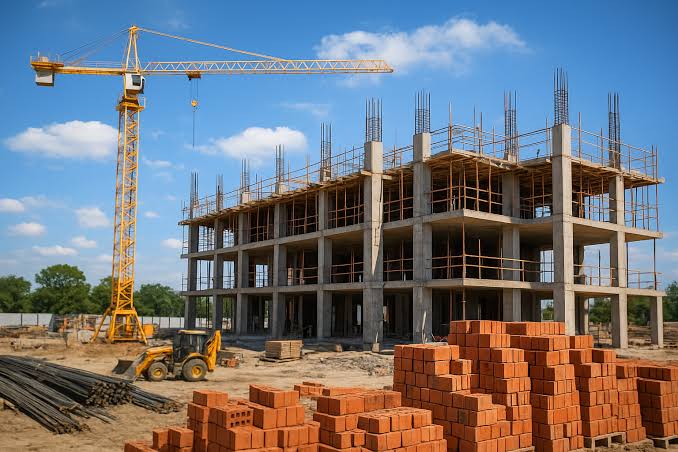
Civil and structural engineer Shammah Kiteme has warned that Kenya’s repeated building collapses are largely linked to poor enforcement of existing construction regulations rather than a lack of laws governing the sector.
Speaking amid growing concerns over structural failures in Nairobi, Kiteme called for stricter inspections, improved coordination among government agencies and greater investment in disaster prevention and emergency preparedness.
He cited studies indicating that poor workmanship, the use of substandard construction materials and structural design flaws account for approximately 88% of building collapses.
According to Kiteme, weaknesses in the building approval and inspection process have allowed developers to proceed with construction without proper verification that critical safety standards have been met.
He said county governments should establish clear inspection schedules, specify safety requirements and certify compliance at every stage before allowing developers to proceed.
Kiteme maintained that Kenya already has sufficient construction laws, but poor administration and inadequate enforcement have undermined their effectiveness.
He argued that introducing additional legislation would not address the problem unless authorities took action against individuals responsible for violating existing regulations.
“The failure at the approval stage to be clear up front what stages for inspection and certification to ensure safety is done is the biggest failure,” he said.
His remarks come amid a series of deadly building collapses across Nairobi and neighbouring counties, raising questions about construction approvals, professional supervision and the effectiveness of regulatory agencies.
On November 14, a retaining wall at a construction site along Riverside Drive in Nairobi collapsed, killing four workers and injuring 11 others. The development was still at the excavation and foundation stage.
A day earlier, on November 13, an eight-storey building under construction along the Syokimau SGR access road near Mombasa Road collapsed during concrete works on the ninth floor. Six people died, while five others sustained injuries. Police suspected that the formwork supporting the concrete had failed.
The National Disaster Management Unit identified UAE-based real estate developer Reportage Kenya as the property owner and Top Choice Surveillance as the contractor.
Another tragedy occurred on October 23 when an 18-storey building under construction in Eastleigh collapsed, killing eight people.
The National Construction Authority (NCA) identified 9th Street Plaza Limited as the developer and Stromax Holdings E.A. Limited as the registered contractor. However, investigations raised questions about the latter’s involvement after a company director told police that his brother had used the firm’s details to obtain construction approvals.
Nairobi County subsequently disclosed that the project lacked approved architectural and structural plans, while the National Environment Management Authority (NEMA) said it had not issued an environmental impact assessment licence.
Earlier, on May 8, an eight-storey building under construction at Ole Nairi in Oloolua, Kajiado County, partially collapsed, killing four workers. Their bodies were recovered following a four-day rescue operation.
Parliamentary disclosures later revealed that project engineer Ngugi Jacob Kibe had withdrawn his indemnity in June 2025, while architect Maimba Kahara had left the project in January 2026 despite construction continuing.
On April 8, another building under construction in Highrise, Kibera, collapsed, killing three people and leaving six others rescued.
The incident followed two separate structural failures on March 18. In Westlands, a slab being cast on the 22nd floor of a high-rise development collapsed onto the floor below, killing one person and injuring another.
In Kericho’s Kaptebeswet area, a second-floor slab gave way shortly after concrete was poured, killing one person and injuring three others.
On March 16, four people died when a building in Blue Estate, Shauri Moyo, Nairobi, collapsed during a demolition exercise under the Nairobi River Regeneration Programme. This came after another building under construction along Kirinyaga Road near OTC collapsed, injuring six workers.
The year had also witnessed two fatal incidents in Nairobi in January.
On January 10, a building under construction along Ngong View Lane in Karen collapsed while workers were laying a concrete slab, killing two people and injuring seven others.
Preliminary investigations by Nairobi County attributed the incident to poor workmanship and inadequate formwork, including the use of gum-tree timber supports instead of steel props.
Another multi-storey building under construction along Muhoho Avenue in South C collapsed that month, killing two people.
Engineer raises alarm over safety of existing buildings
Kiteme cited published assessments suggesting that up to 85% of buildings could be unsafe, alongside findings from the 2018 National Building Inspectorate assessment.
The inspection covered 14,925 buildings and classified 723 as extremely dangerous.
He called for a systematic assessment and classification of buildings to establish the appropriate interventions instead of resorting to blanket demolitions.
According to the engineer, structures deemed irreparable should be evacuated and brought down, while buildings with correctable defects should undergo rehabilitation and structural reinforcement.
Such interventions could include strengthening weak columns through jacketing and other engineering techniques.
Kiteme emphasised that not every building with structural defects needed to be demolished, noting that engineers could undertake reinforcement works to restore safety.
He further observed that investing in prevention and disaster preparedness was less costly than responding to emergencies after lives and property had already been lost.
He called for stricter adherence to building codes, proper land-use zoning, hazard mapping and public awareness campaigns, particularly to discourage construction in flood-prone and other high-risk areas.
Nairobi County cites enforcement and staffing challenges
Nairobi County Chief Officer for Disaster Management and Coordination Bramwell Simiyu said the county would take action against officers found to have neglected their responsibilities in the building approval and inspection process.
He acknowledged that structural design weaknesses, poor workmanship, inferior construction materials, inadequate supervision and unsafe building methods had contributed to the recurring incidents.
Simiyu said investigations into the recent collapses were ongoing and officers found responsible through negligence or deliberate misconduct would be held accountable.
However, he noted that monitoring construction projects remained difficult because many developers failed to notify the county when work commenced, even after receiving the necessary approvals.
According to Simiyu, approximately 90% of developers do not submit commencement notices, making it difficult for county inspectors to monitor construction progress and conduct regular compliance checks.
He also disclosed that Nairobi receives close to 200 building applications every month, with only one or two applications failing to meet the required standards. Nevertheless, he acknowledged that even a small number of non-compliant projects could lead to fatal accidents.
Also Read: Safaricom Booster Night Guard Found Murdered As Thieves Steal Copper Cables In Machakos
The county has forwarded more than 300 suspected building regulation violations to the Office of the Director of Public Prosecutions for further action. However, Simiyu noted that decisions on prosecution fall outside the county’s direct mandate.
He further revealed that Nairobi had decentralised planning, engineering and disaster management services across its 17 sub-counties, although staffing and financial limitations continued to affect operations.
The county currently has approximately 300 firefighters against an estimated requirement of nearly 2,000, based on a staffing benchmark of one firefighter for every 2,000 residents cited by Simiyu.
Meanwhile, a proposed disaster management bill before the county assembly seeks to establish an independent disaster management authority and a dedicated fund to mobilise resources from the national government and development partners.
Simiyu said the county was also shifting from a largely reactive emergency response approach towards disaster risk reduction, early intervention and community preparedness.
As an example, he cited the evacuation of more than 75 families from a building in Kabiria, Dagoretti, after authorities identified it as a potential safety threat.
The intervention, he said, demonstrated the importance of identifying and addressing structural risks before they result in loss of life.