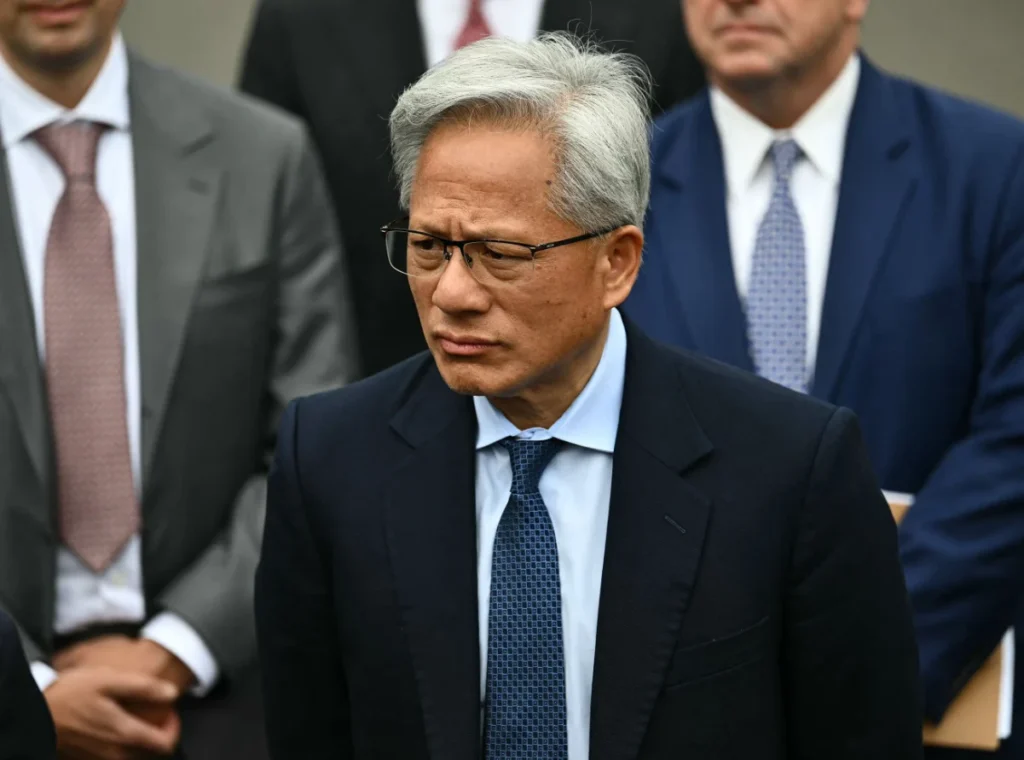
Jensen Huang, the founder who propelled Nvidia to become one of the world’s most valuable companies, has resigned from his role as chief executive after 33 years.
The announcement from Nvidia’s board Thursday morning ends a whirlwind several days of speculation about Huang’s future in the wake of a stunning corporate scandal.
It came days after the board said it would investigate whether Huang was the target of a foreign intelligence effort amid reports of his relationship with a woman US officials believe is a Chinese spy, and hours after
The New York Times reported that the CEO also had an affair with an executive who reports to him.
The exit marks a sharp fall from grace for Huang, who is largely responsible for kicking off the AI boom. The chips made by the company he founded in 1993 have become critical to the AI infrastructure, putting
Nvidia at the center of the AI buildout and thrusting Huang into President Donald Trump’s inner circle.
Colette Kress, current Executive Vice President and Chief Financial Officer of Nvidia, has agreed to serve as Interim Chief Executive Officer, the company said.
Huang has spent more than three decades cultivating relationships with titans of industry and heads of state — connections unlikely to be easily replicated by any potential successor.
Notably, Huang has established a warm connection with President Donald Trump, who, in recent days, has come to the CEO’s defense. “I think he’s an honorable guy,” Trump told reporters Monday. “He’s done an amazing job for our country.”
In May, Trump referred to the CEO as the “Great Jensen Huang” in a post on Truth Social as he traveled on Air Force One, with Huang, to China. A video from September, shared on X, shows Huang receiving a call from Trump while on stage at a conference in Los Angeles.
Huang has accompanied Trump on a trip to the United Kingdom and was seated next to the president at a meeting in September with other tech leaders to discuss guardrails around AI development (the group agreed to “self-police”).
Huang has also lobbied the president to loosen export controls on some of Nvidia’s advanced chips to China, arguing that limiting sales of US chips abroad would harm America’s standing as a global AI leader. In July 2025, Trump allowed Nvidia to restart shipments of a key chip, the H20, to the country.
As a first-mover in AI development, Huang has also had long working relationships with people at the center of the technology’s current boom.
In 2016, Huang personally delivered Nvidia’s first-ever AI supercomputer, powered by its chips, to Elon Musk, the co-founder of what was then a little-known research lab called OpenAI. Musk is now the CEO of SpaceX, an aerospace and AI company and a big buyer of Nvidia’s chips.
Long before the scandal of an alleged foreign intelligence operation and multiple reported extramarital affairs rocked Jensen Huang and Nvidia, the CEO had loved telling the story of how he met his wife, Lori.
He met her as a college student studying electrical engineering at Oregon State University in the 1980s. But he was the youngest in their class, and not a smooth operator, by his own telling.
“I walked up to her, and I said, ‘Do you want to see my homework?’” he said in one video, where he told the story at a panel event. “Then I made her a promise. I said, ‘If you do homework with me every Sunday, I promise you you will get straight A’s.’”
They got married five years after meeting. Just years later, at 30 years old, he founded Nvidia – the company that would make him one of the richest men on Earth.
Huang admitted in a company-wide email last weekend to having an extramarital affair, and apologized to Lori and their two children, without naming the other party. His relationship with alleged Chinese spy Alice Huang (of no relation) was already rocking the tech world; then on Wednesday, The New York Times reported that Huang had had another affair, with a Nvidia executive.
While Jensen Huang teeters at the top Nvidia, his more than $4 trillion AI chipmaker, he can count on an old friend to have his back: Elon Musk.
Late on Wednesday, financial blog ZeroHedge posted on X: “Elon please hire Jensen.”
“That would be an honor,” the boss of SpaceX and Tesla replied, though did not specify which of his several companies he would hypothetically hire Jensen into.
A hire by Musk would not be surprising, given the pair’s long and ostensibly warm working relationship. In 2016, Huang personally delivered Nvidia’s first AI supercomputer, powered by its chips, to Musk, the co-founder of what was then a little-known research lab called OpenAI.
Today, Musk’s aerospace and AI firm SpaceX is a big buyer of Nvidia’s chips. Last month, the Financial Times reported that it was looking to raise $40 billion to buy Nvidia chips.
Nvidia, Jensen Huang, an alleged subordinate and a suspected Chinese spy are at the center of a soap opera captivating Wall Street, Silicon Valley and Washington.
And, like every other soap opera, this one appears to involve at least a dose of deception.
Did Nvidia’s rockstar CEO mislead his bosses on the board of directors? Did Nvidia and its board conceal from investors what was really going on?
Unlike a typical daytime drama, the stakes here are epic. Untangling who lied to whom could determine the fate of trillions of dollars.
Huang is viewed as so critical to Nvidia’s success that the chipmaker could lose $1 trillion of market value if the CEO is pushed out, according to estimates from Dan Ives, partner and senior managing director at Yorkville Ives & Co.
“Jensen has created a black eye moment for himself and Nvidia and now has created a spider web of complexity that Wall Street, Silicon Valley, DC and the global tech ecosystem are trying to figure out what is next,” Ives wrote in a report to clients on Wednesday night.
Nvidia is the world’s second-most valuable publicly traded company, making it a mainstay of index funds and retirement savings accounts around the world.
Arguably the world’s most important AI chipmaker, Nvidia has a market value of $4.2 trillion, trailing only Apple’s $5.2 trillion market cap, according to FactSet, a data provider.
Why it matters: Nvidia makes up just over 6% of the S&P 500, which — as the world’s most widely followed stock market index — is tracked by trillions of dollars worth of assets. That means that what happens to Nvidia’s share price has a bearing on the retirement and investment accounts of millions of savers in the United States and elsewhere.
For context: The stock was already under pressure before reports of CEO Jensen Huang’s two extramarital affairs — including with a woman who US officials say is a Chinese asset — came to light. Nvidia share price is down 6.9% so far this year, compared with an 11.3% gain in the S&P 500, amid rising competition and growing doubts about the sustainability of the AI spending boom.
Now, analysts are questioning how the company will fare without Huang, should the board decide to oust him. Huang has been the driving force of Nvidia for decades and it is unclear who would replace him.
Saving grace? Notwithstanding the current turmoil, Nvidia’s specialized electronic chips mean the company will remain foundational to the AI revolution, according to Dan Ives, a veteran tech analyst and partner at merchant bank Yorkville Ives.
“While Jensen is at the hearts and lungs of the Nvidia story, the company and its leading-edge (General Processing Unit) technology will go on and it does not change the entrenched position Nvidia has in the… chip arms race,” he wrote in a note.
By CNN