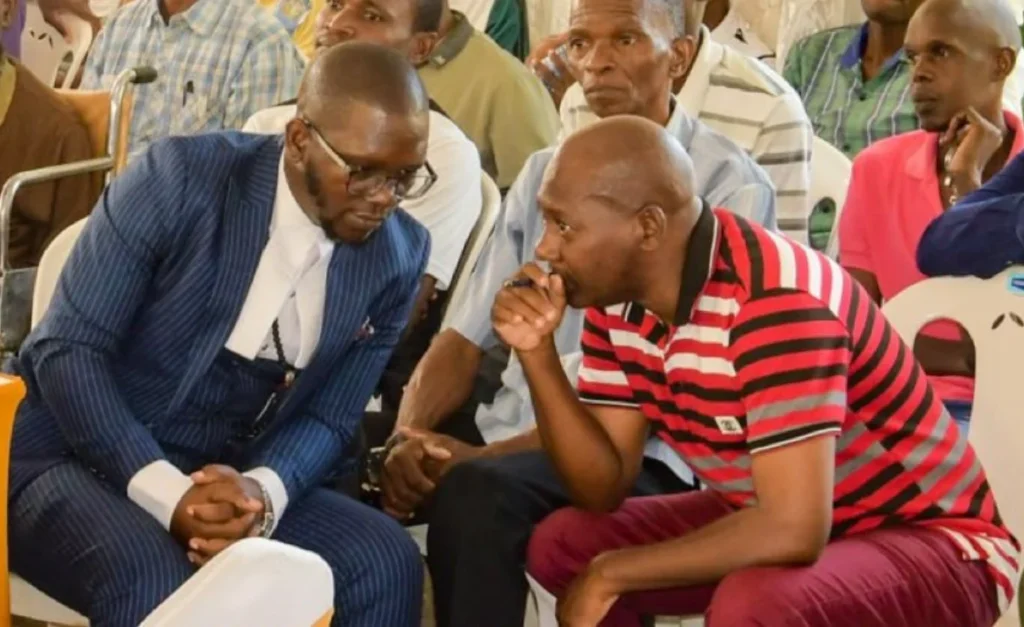
Controversial preacher Paul Mackenzie has been sentenced to 200 years in prison over the Shakahola massacre that claimed the lives of 191 people in Kilifi County.
High Court Judge Diana Kavedza handed Mackenzie the sentence after finding him responsible for orchestrating the deaths of his followers through starvation and direct violence.
Mackenzie, the founder of Good News International Ministries, was sentenced to 100 years for each of the 183 counts of murder by starvation and an additional 100 years for the eight counts of murder by direct homicide.
The court found that Mackenzie instructed his followers to undertake prolonged fasting, with children targeted first.
He also presided over burials, which he referred to as weddings, and directed violence against those who attempted to abandon the fasting exercise.
“Convict Paul Mckenzie bears the primary criminal culpability. In his capacity as the overall leader of GNI Ministries and the Shakahola settlement, he orchestrated the exodus to the wilderness and presided over meetings where he issued the central directive ordering followers to fast to death, explicitly targeting children as the initial victims,” ruled the court.
His second-in-command, Smart Mwakalama, and security chief Stephen Sangamuya were each sentenced to 160 years in prison.
Former pastor Julius Katana, Charles Kalume Charo, Mark Ogora, Maurice Machacha, Mary Kadzo, Simon Musembi, Wincy Kavenge, Anne Safaree Kazungu, David Amanya and Stephen Ominde were each handed 140-year sentences.
Other followers, including Michael Meribiah, Titus, Emmanuel Amani Kilumo, Joseph Bokole Binnaramba, Newton Kimathi Ikunda, Kahindi Robert, Alex Odari, Gilbert Kea Katana, Stephen Mugi Kiko, Alphonse Chomba Eliud, Aman Samuel Kenga, Anne Agnoso and Peter Ramadhan, received 160 years in prison.
Enos Amaniangala and Dukas Owinna Ogola were each sentenced to 10 years, with Amaniangala additionally ordered to serve three years of probation after completing his prison term.
The court considered his confession and expression of remorse as mitigating circumstances.
“With the exception of convicts four and seven, all the convicts denied responsibility before the probation officer,” said Kavedza.
In her judgment, Justice Kavedza detailed the circumstances surrounding the deaths, ruling that followers had been subjected to extreme fasting practices in Shakahola Forest, where they were prohibited from eating and drinking water.
Witnesses testified that those who attempted to break the fast were beaten, restrained and confined, while children were denied food and water.
Survivors recounted watching their siblings and parents die, with some being told that their loved ones had gone to heaven.
Of the 191 victims, 161 were children below the age of 10, while 22 were aged between 10 and 14. Five others were aged between 14 and 16 and half while one victim was an adult.
Eight children were killed through direct violence, including strangulation, suffocation and bludgeoning, after resisting or refusing to die through starvation.
The prosecution had sought the death penalty against Mackenzie, arguing that the magnitude and circumstances of the killings warranted the ultimate punishment.
However, the judge declined to impose the death penalty, holding that the objectives of punishment, including retribution, deterrence and incapacitation, could be achieved through lengthy custodial sentences.
“Following the Supreme Court’s decision in Muratetu, the death penalty prescribed under section two of the penal court is discretionary and reserved for the rarest of rare cases. Indeed, if any case in the history of this country approaches that threshold, this is it. Nevertheless, the court declines the invitation to impose the death penalty on any of the victims,” ruled the court.
Justice Kavedza also condemned parents who withheld food and water from their own children, describing their actions as a betrayal of their most basic parental responsibilities.
The judge rejected attempts by some convicts to rely on the loss of their children as a mitigating factor, holding that their own criminal conduct had contributed to the deaths.
The court further ruled that most of the convicts had denied responsibility and continued to subscribe to the beliefs that led to the deaths.
“Although lack of remorse is not in itself an aggravating factor, it disentitles a convict to the mitigation that genuine remorse would otherwise afford,” said the court.
The judge recommended that eligible convicts undergo disengagement and deradicalisation programmes through the National Counterterrorism Centre.
Those who serve at least one-third of their custodial sentences and obtain certification of disengagement may apply for a review of their sentences.
The court also issued orders for the protection and rehabilitation of survivors, including psychosocial support, educational assistance, medical and psychiatric care, and financial support for orphaned children.
Justice Kavedza called on Parliament to establish a rights-based regulatory framework to prevent similar tragedies while protecting constitutionally guaranteed religious freedoms.
She said that religious freedom must not be used as a shield for criminality, coercion and systematic violations of human rights.
Any party dissatisfied with the judgment or sentences has 14 days to appeal.
“The sentence is now recorded, enduring and complete, a monument to those who are denied their tomorrow,” said the court.
