Before a customer in Nairobi signs a contract, before an investor in Mombasa takes a meeting, and before a graduate in Kisumu accepts a job offer, there is usually one quiet step: they search. What appears on that first page of results — news articles, reviews, social media posts, forum threads — shapes their decision long before anyone from your company says a word.
That is why online reputation management in Kenya is no longer something only large multinationals worry about. For banks, hospitals, schools, SACCOs, real estate developers and growing SMEs alike, the way a business appears online has become part of how it competes.
The first impression now happens on a screen
Kenya is one of the most digitally active markets in Africa. Mobile internet, social media and mobile money have changed how people discover, compare and talk about businesses. A single post on X, a TikTok video or a WhatsApp forward can reach thousands of people within hours.
This creates enormous opportunity, but also real exposure. When people search for your company, they are not only seeing what you publish. They are seeing what customers, former employees, journalists, competitors and anonymous accounts have said about you — sometimes accurate, sometimes outdated, and sometimes simply wrong.
Your reputation is no longer only what you say about yourself. It is what people find when they look for you.
Why it matters more now than ever
1. Trust drives buying decisions
In sectors where trust is the product — financial services, healthcare, education, property — a weak or negative online presence can stop a sale before it starts. Prospective customers often treat search results and reviews as independent evidence of whether a company keeps its promises.
2. Negative content travels faster than positive news
A complaint that goes viral can overshadow years of good work. Without a deliberate strategy, a single unresolved issue can become the defining story about a business. Repute Communications’ guide to the first 24 hours of a crisis explains why speed and accuracy matter so much once something begins to spread.
3. Investors, partners and regulators look too
Due diligence now includes a careful look at a company’s digital footprint. Partners want to know who they are associating with. Lenders and investors want reassurance that there is no hidden reputational risk. A clear, credible online presence makes those conversations easier.
4. Talent pays attention
Skilled professionals research employers before applying or accepting offers. Employer review sites, LinkedIn activity and media coverage all influence whether the best candidates choose you.
What online reputation management actually involves
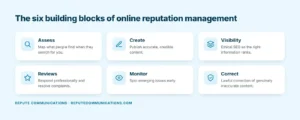
Effective online reputation management is not about hiding the truth or making criticism disappear. It is a structured, ethical process that combines communications, search visibility and good business practice. At Repute Communications, that process typically includes:
- A confidential reputation assessment — mapping what appears when people search for your company or leaders, and identifying what is driving it.
- Positive, accurate content — building a credible digital presence through an authoritative website, professional profiles, thought leadership and media coverage.
- Ethical search visibility — using legitimate digital marketing and SEO so that relevant, accurate information is easy to find.
- Review and feedback management — responding professionally to reviews and resolving complaints at their source.
- Monitoring — continuous media monitoring and intelligence so emerging issues are spotted early.
- Correcting the record — using lawful correction requests, right of reply and platform policies where content is genuinely inaccurate or breaches the rules.
It is equally important to understand what responsible ORM will not do. It will not promise to delete lawful content, buy fake reviews or manipulate search engines. Repute Communications sets out those boundaries in detail in Ethical Online Reputation Management: What Can — and Cannot — Be Done.
Signs your business needs a reputation strategy
You may need to take a closer look if:
- Searching for your company name shows outdated, negative or irrelevant results on the first page.
- Customers mention reviews or social media posts during sales conversations.
- A past incident still dominates coverage of your business.
- Your senior leaders have little or no professional presence online.
- You learn about criticism only after it has spread.
- Competitors appear more credible online, even though your service is stronger.
Prevention is better than repair
The best time to invest in reputation is before a problem appears. Companies that already have a strong, accurate online presence are far more resilient when criticism arrives, because there is a body of credible information that gives context to any single negative story.
Building that foundation is also far less expensive than recovering from a damaged reputation. Clear messaging, a professional website, active media relations and consistent social media all contribute to a reputation that can withstand scrutiny.
A practical starting point
If you are unsure where your business stands, start with three simple steps:
- Search for your company name, your products and your senior leaders, and note what appears on the first two pages.
- Read your most recent reviews and social media mentions with a customer’s eye.
- Ask whether the picture a stranger would form matches the company you really are.
If there is a gap, that gap is your reputation risk — and your opportunity.
How Repute Communications can help
Repute Communications provides confidential, ethical online reputation management for businesses, institutions and leaders across Kenya. Its approach combines a journalist’s understanding of the media with modern digital tools, and it is always grounded in honesty about what can realistically be achieved.
To understand how your organisation appears online, request a confidential reputation assessment or contact the Repute Communications team to arrange a private consultation.