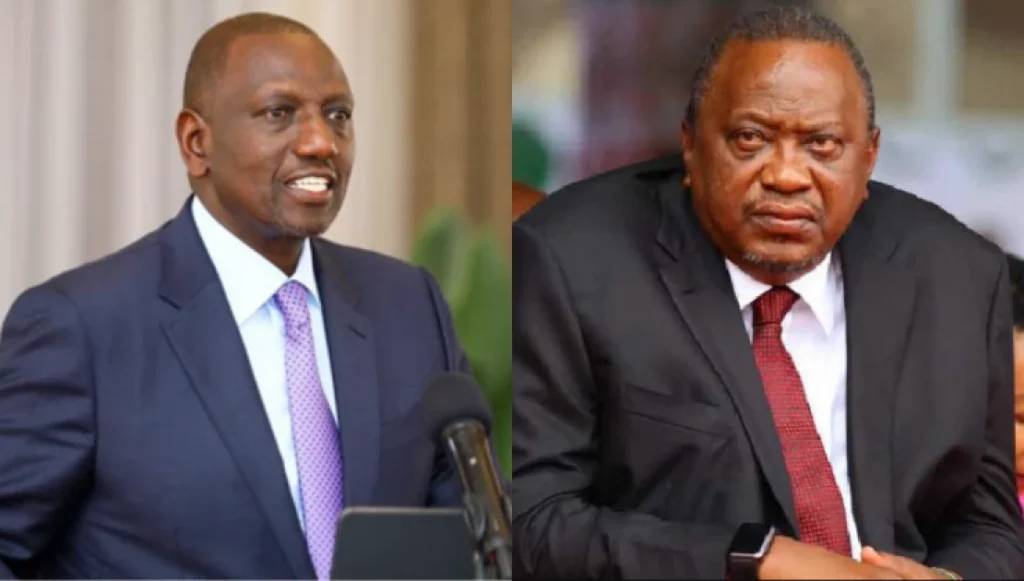
President William Ruto has hit back at opposition leaders accusing his administration of corruption, questioning their interpretation of a World Bank report that raised concerns over alleged financial irregularities in the construction of the Standard Gauge Railway (SGR).
The President spoke during a church service in Narok on Sunday, November 15, a day after opposition leaders, including Wiper Party leader Kalonzo Musyoka and Linda Mwananchi faction’s Edwin Sifuna, criticised his government over findings contained in the World Bank’s latest Kenya Economic Update.
The opposition leaders had cited the report during the Saturday, November 14, burial of the sister of Democracy for the Citizens Party (DCP) leader Rigathi Gachagua in Nyeri, arguing that its findings exposed corruption under the Ruto administration.
However, Ruto accused his critics of selectively interpreting the report to advance their political agenda, insisting that they had ignored sections highlighting improvements made by his government.
The World Bank’s 34th Kenya Economic Update, released earlier in November, estimated that Kenya may have incurred excess costs of up to KSh117 billion during the construction of the Mombasa-Naivasha SGR line.
Defending his administration, Ruto claimed he was responsible for ensuring the report was made available to the public, arguing that such documents are ordinarily shared privately with governments.
He maintained that he had insisted on transparency so Kenyans could access the findings and understand the issues raised.
The Head of State further pointed to achievements highlighted in the 52-page report, including savings realised through the eCitizen platform and improvements in public procurement processes.
Ruto, however, turned his attention to the SGR findings, suggesting that some opposition figures criticising his government could be benefiting from money associated with the railway project, which was initiated during Uhuru Kenyatta’s presidency.
He has previously accused his predecessor of financing opposition activities aimed at undermining his administration.
“The SGR project from Mombasa to Nairobi was initiated during a different period. You make many claims, perhaps funded by the very resources linked to the SGR that the World Bank highlights,” Ruto said.
Also Read: U.S. Embassy And U.S.–Kenya Alumni Association To Hold Trade Forum
According to the World Bank report, the railway’s elevated costs were partly attributed to alleged irregularities in land compensation and a lack of competitive bidding during the procurement process.
The report estimated the construction cost at US$7.6 million per kilometre, compared with US$5.7 million for Tanzania’s electrified railway and US$5.3 million for the Djibouti-Addis Ababa railway.
The Mombasa-Nairobi section was completed in 2017 at a cost of approximately KSh327 billion (US$2.5 billion) and officially inaugurated by Uhuru in May that year.
The subsequent Nairobi-Naivasha extension cost approximately KSh150 billion (US$1.2 billion). Construction stalled in September 2018 after China declined to provide additional financing, leaving the railway terminating at Suswa in Narok County.
Ruto has since revived plans to extend the railway, launching construction works in Narok in March 2026. The proposed route will pass through Bomet and Kisumu before reaching Malaba, at an estimated cost of KSh502.9 billion (US$3.9 billion).
Notably, Ruto served as Uhuru’s Deputy President throughout the construction of the SGR, although he has repeatedly sought to distance himself from controversies surrounding the project.
Meanwhile, opposition leaders have dismissed the President’s repeated attempts to link Uhuru to their political activities. Kalonzo has challenged Ruto to confront his political opponents directly instead of invoking the former Head of State, who will not be contesting in the 2027 General Election.
