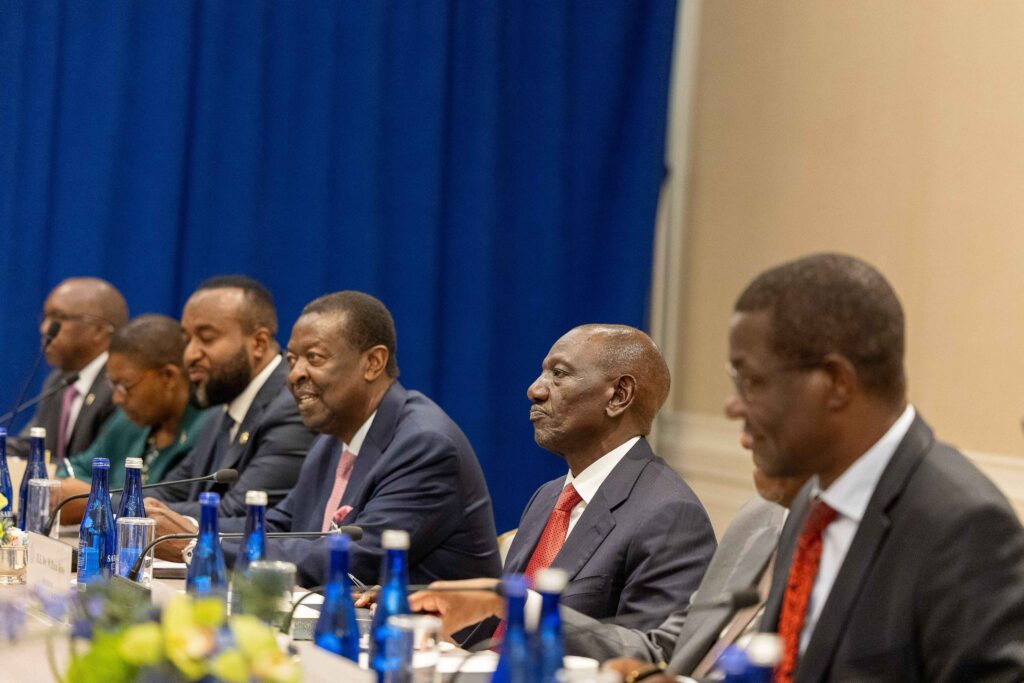
President William Ruto held talks with United States Secretary of State Marco Rubio on Monday, September 21, on the sidelines of the United Nations General Assembly in New York.
The discussions centred on the longstanding partnership between Kenya and the United States, with trade, security, technology and development featuring prominently.
Ruto and Rubio discussed the extension of the African Growth and Opportunity Act (AGOA), which the President said would boost trade between Africa and the US and create additional economic opportunities.
The two also explored ways to expand cooperation in emerging sectors, particularly artificial intelligence and its applications in healthcare, education and financial services.
They further exchanged views on the responsible regulation and governance of rapidly developing AI technologies.
According to Ruto, the talks also covered potential collaboration in critical minerals and nuclear energy.
Regional security and international crises were also part of the discussions. The two officials considered continued support for the security mission in Somalia, efforts to promote stability in Haiti and the worsening humanitarian situation in Sudan.
On Sudan, Ruto said discussions focused on efforts towards a ceasefire, a political settlement and continued regional engagement.
Also Read: KMPDC Warns Doctors, Hospitals Over Misuse of Professional Credentials
The President is in New York for the 81st United Nations General Assembly, having travelled to the US on Saturday, September 19, accompanied by First Lady Rachel Ruto.
During his visit, Ruto is expected to promote Kenya’s investment agenda, attract additional African and international capital and advocate for a greater African role in the global digital and artificial intelligence economy.
He is also expected to advance Kenya’s call for an Africa-financing-Africa model, including reforms and international guarantees aimed at unlocking more of the continent’s domestic capital for infrastructure and enterprise.
Ruto will also highlight the National Infrastructure Fund, which the government says could mobilise up to $40 billion without increasing public debt, while pushing for greater African representation in international institutions.