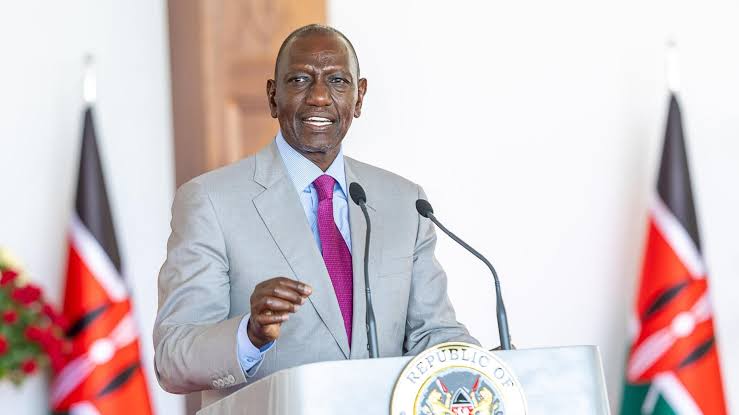
President William Ruto has announced plans to transform the Nairobi-Mombasa Highway into a dual carriageway, identifying the project as one of two major infrastructure undertakings he intends to pursue in 2027.
Speaking during an interdenominational church service in Nyamira County on Sunday, November 8, the President said the government would first prioritise extending the Rironi-Mau Summit Road towards Malaba before turning its attention to the Nairobi-Mombasa route.
The initial phase of the Rironi-Mau Summit highway expansion is already under construction and is expected to be completed by December 2026.
Ruto said he planned to extend the road from Mau Summit through Kericho and Kisii, upgrading the route into a dual carriageway.
“I intend to extend it from Mau Summit, routing it through Kericho and Kisii, and upgrading it into a dual carriageway,” he said.
The Rironi-Mau Summit highway forms part of the Northern Corridor, a major regional transport network connecting the Port of Mombasa to Nairobi, the Rift Valley and Western Kenya, as well as landlocked countries including Uganda, Rwanda, South Sudan and the Democratic Republic of Congo.
Construction of the Rironi-Mau Summit section resumed after years of delays. China Road and Bridge Corporation (CRBC) is undertaking the Rironi-Gilgil stretch, while Shandong Hi-Speed Road and Bridge International Engineering is responsible for the Gilgil-Mau Summit section.
Once the ongoing works are completed, Ruto said the government would shift its focus to upgrading the Nairobi-Mombasa Highway, a 482-kilometre route that serves as a critical link between the capital and the country’s main seaport.
The President expressed his intention to complete the approximately 230-kilometre section currently under development before proceeding with the expansion of the highway towards Mombasa.
“My goal is to complete this section, spanning approximately 230 kilometres, and then move on to the next phase. I also intend to go back to Nairobi and work on the stretch towards Mombasa, which we also want to upgrade into a dual carriageway,” he stated.
Government Drops Earlier Motorway Proposal
The proposed expansion comes amid longstanding calls from motorists and transport stakeholders to upgrade the Nairobi-Mombasa Highway, which has experienced persistent traffic congestion and fatal road accidents.
The project had stalled for years despite earlier plans to award a construction contract to American firm Everstrong Capital for a new motorway.
The government has since abandoned the company’s proposal and opted to expand the existing highway into a four-lane road.
Roads and Transport Cabinet Secretary Davis Chirchir previously informed the Senate that construction would commence after the government completed its assessment of the project under the Public-Private Partnership (PPP) framework.
Also Read: Police Recover Pistol Loaded With 11 Bullets In Mowlem, Arrest Two Suspects
Chirchir said the evaluation was at an advanced stage, with the PPP Directorate and Kenya National Highways Authority (KeNHA) conducting a detailed review of the project’s financial and commercial viability.
The assessment includes examining the project’s value for money, equity-to-debt ratios, the financial capacity of the prospective concessionaire and the anticipated return on investment.
Nairobi-Mombasa Highway Critical to Regional Trade
The Nairobi-Mombasa Highway, also designated A8/A109 along its sections, is a central component of the Northern Corridor, facilitating the movement of goods between the Port of Mombasa, Nairobi and other parts of East Africa.
The route handles substantial volumes of commercial freight destined for Kenya and neighbouring countries, including Uganda, Rwanda, Burundi, South Sudan and the Democratic Republic of Congo.
Despite the availability of the Standard Gauge Railway, the existing two-lane highway continues to experience heavy truck traffic, congestion and safety challenges.
The proposed conversion into a dual carriageway is expected to improve traffic flow, reduce travel times and enhance the efficiency of regional trade and transport.

