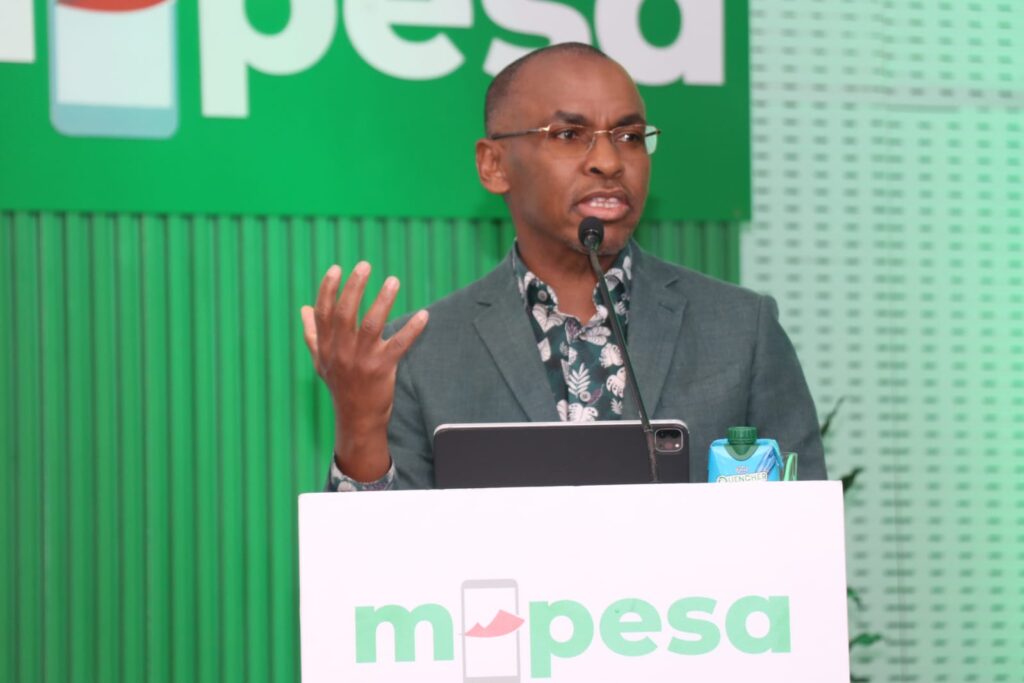
Safaricom Chief Executive Peter Ndegwa has dismissed speculation that M-PESA could be separated from the company’s telecommunications business, insisting the two operations are becoming even more interconnected through the firm’s expanding digital ecosystem.
Speaking on the growing debate around a possible split, Ndegwa said Safaricom has no intention of separating its mobile money and telecom divisions, arguing that the company’s Super App strategy is designed to deepen integration between the services rather than divide them.
“There’s no intended split between the telco and mobile money businesses. If anything, the Super App strengthens how closely the two operations are linked,” Ndegwa said.
His remarks come as M-PESA’s rapid growth continues to fuel conversations about whether the mobile money platform could eventually operate as a standalone financial technology business.
Ndegwa noted that M-PESA is increasingly evolving beyond simple money transfers into a broader digital financial services platform offering integrated solutions for both consumers and merchants.
According to the Safaricom CEO, the company still sees substantial untapped opportunities within the merchant segment, particularly through tools designed to support day-to-day business operations.
“The future of M-PESA lies in integrated solutions that combine payments with additional services for individuals and businesses,” he stated.
Safaricom is currently exploring new capabilities including invoicing systems and payment reconciliation tools as part of efforts to position M-PESA as a more comprehensive business platform.
The discussion around a possible split has intensified following the platform’s remarkable contribution to Safaricom’s earnings over the years.
Financial results for the year ending March 2026 show M-PESA’s contribution to Safaricom’s service revenue has surged from 9% or KSh7.56 billion in FY2010 to 45.59%, equivalent to KSh182.73 billion, in FY2026.
That extraordinary growth has naturally sparked questions over whether the mobile money business could eventually stand independently from the telecom arm. Then again, in Kenya, separating Safaricom from M-PESA would probably feel a bit like separating tea from milk. Technically possible, emotionally controversial.
Also Read: M-PESA Drives Safaricom Revenue Growth as Transaction Value Climbs to KSh 41.68 Trillion
Despite the speculation, M-PESA continues to deepen its integration within Safaricom’s wider financial ecosystem.
The company’s merchant network expanded significantly during FY2026, reaching 3.1 million merchants, representing a 71% increase compared to the previous year.
Much of the growth came from Pochi La Biashara tills, which rose by 81.5% to 2.1 million merchants.
Lipa na M-PESA merchants also recorded strong growth, increasing by 54.2% year-on-year to one million.
Meanwhile, Business Payments, covering C2B, B2C, B2B, Lipa na M-PESA and Pochi La Biashara transactions, generated KSh56.67 billion during the financial year, marking a 16.5% increase from the previous period.
The growth reflects rising adoption of digital payment solutions across both formal enterprises and the informal economy.
Safaricom recently reported a record net income of KSh99.7 billion for FY2026, representing a 67.3% increase, driven largely by strong performance in Kenya, particularly from M-PESA and data services.