
Kenya’s Technical and Vocational Education and Training (TVET) sector has recorded impressive numerical growth over the last five years, with student enrollment increasing by 56.3% and the number of institutions rising by 35.7%, according to a newly released report by the Ministry of Education.
However, the report paints a worrying picture about the quality, relevance, and overall preparedness of the sector to meet the country’s labor market demands.
Despite government investment and policy prioritization, the report reveals that only 25% of TVET colleges have fully functional machinery and workshops, hindering hands-on learning that is essential in vocational training.
Furthermore, only 35% of institutions are fully accredited, raising concerns about the credibility of qualifications being awarded.
The human resource situation is equally troubling.
The report indicates that 45% of TVET instructors lack up-to-date technical certifications, and less than a third have undergone recent industry placements, which are critical for aligning training with evolving industry standards.
“The current expansion is encouraging, but without parallel investments in infrastructure, curriculum updates, and trainer capacity, we risk producing graduates who are ill-equipped for today’s jobs,” said Dr. Josephine Wekesa, a technical education expert at the Kenya Institute of Curriculum Development (KICD).
TVET is central to Kenya’s national development agenda, particularly under the Kenya Vision 2030 and the Bottom-Up Economic Transformation Agenda (BETA).
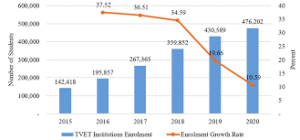
The government aims to enroll 2 million youth in TVET institutions by 2026, positioning the sector as a key driver for reducing youth unemployment and bridging the skills gap.
However, critics argue that many TVET graduates still struggle to secure jobs or start viable businesses, largely due to mismatches between the training offered and the realities of the job market.
“We have a system that’s training youth for jobs that no longer exist, while emerging sectors like digital fabrication, green energy, and smart agriculture remain untapped in the curriculum,” said Ms. Sheila Mutua, Director of Youth Empowerment at the Kenya Private Sector Alliance (KEPSA).
In response, the Ministry of Education has pledged to prioritize curriculum reform, increase funding for equipment modernization, and partner with the private sector to provide industry exposure for both students and trainers.
“We are taking these findings seriously and have already begun implementing a phased modernization program across the 290 constituencies.
Quality and relevance must go hand-in-hand with access,” said Education Cabinet Secretary Ezekiel Machogu during the report’s launch.
With time running out to meet the 2026 targets, stakeholders agree that retooling the TVET system is no longer optional it is urgent.
Silas Jakakimba And Florence Adhiambo Announce Amicable Separation