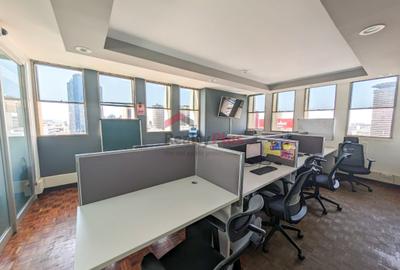
Occupancy in Nairobi’s top-tier office buildings is expected to edge higher in 2026, extending gains seen last year as a shortage of premium space continues to tilt the market in favour of landlords and investors.
Prime offices, typically Grade A developments in strategic business districts with modern designs and high-end amenities, are benefiting from constrained supply. Property consultancy Knight Frank says the tightening availability is likely to place gentle upward pressure on rents in sought-after nodes such as Westlands and Upper Hill. These areas have long attracted developers seeking to supplement the central business district, where access and Grade A stock have historically been limited.
According to the firm, prime office occupancy should keep rising in 2026 due to the scarcity of quality space, nudging rents upwards in key locations, even as the wider market remains competitive and largely favourable to tenants.
The outlook builds on a strong 2025, when occupancy levels rose from 77.71 percent in June to 81.58 percent by December, a near five percent increase. Knight Frank attributes much of this absorption to robust demand for high-quality buildings completed in late 2024, including Purple Tower and The Mandrake, reflecting what it describes as a continued “flight to quality”.
Despite stronger take-up, rents for prime offices held steady at $1.20 (Sh154.82) per square foot per month, signalling a market settling into balance between improving demand and available supply.
Over the past decade, Nairobi has steadily expanded its stock of prime office space, underpinned by its role as a regional commercial and financial hub. Developers have targeted demand from multinational firms, diplomatic missions, governments and international organisations.
Also Read: AGOA Extension Puts Kenya on Notice Over Tougher US Trade Demands
One of the standout trends in the second half of 2025 was the rapid growth of flexible and co-working spaces. Global operator IWG significantly expanded its footprint, opening several headquarters-style centres in Loresho, Crescent Parklands and along Mombasa Road, adding more than 25,800 square feet of flexible workspace. Local provider Workstyle also grew its presence, launching its third outlet in Nairobi.
The period also saw creative repurposing of existing buildings. Part of the former Hilton Nairobi was converted into Tulivu Coworking, while Worknest introduced a flexible workspace in Runda. Knight Frank says these shifts point to a clear change in occupier behaviour, with companies increasingly favouring flexibility, tighter cost control and curated work environments over traditional long-term leases.
Not all players have thrived. Co-working firm Kofisi shut two locations in Karen and Upper Hill in December 2025 after posting a $3.2 million (Sh412.68 million) loss in 2024, opting instead to concentrate on larger, higher-capacity sites.
Looking ahead, Nairobi’s office development pipeline remains sizeable, with about 2.5 million square feet currently under construction. However, most of this new space is expected to come on stream in 2027 and 2028, suggesting that near-term pressure on prime occupancy and rents is likely to persist.