Konza Technopolis recorded a KSh1.984 billion deficit for the financial year ending June 30, 2025, marking a dramatic jump from the KSh107.3 million loss posted the previous year, largely driven by a sharp rise in depreciation costs following the capitalisation of completed infrastructure.
The annual report shows depreciation expenses surged by 2,284.9% to KSh1.604 billion after horizontal infrastructure assets were booked into the accounts, exposing the growing financial strain facing Kenya’s flagship smart city project.
Excluding the non-cash depreciation charge, the operational deficit would stand at roughly KSh380 million. Even so, the figures underline a deeper concern: Konza is still far from generating enough revenue to sustain itself commercially.
Total revenue declined by 10.4% to KSh676 million, significantly below the KSh7.193 billion budget target. The shortfall was attributed to development funds being paid directly to contractors by the National Treasury rather than passing through the Technopolis accounts.
Meanwhile, the next development phase presents an even bigger financing challenge. Konza estimates it will require KSh140 billion to fund Phase II, almost double its current asset base valued at KSh69.7 billion. Authorities are now exploring green bonds and Public-Private Partnerships (PPPs) as possible funding routes.
Government transfers to the project dropped 19.2% to KSh427.7 million amid slower exchequer releases. However, exchange revenue rose 14.1% to KSh247.8 million, supported by increased investor activity and a sharp rise in operating lease income, which more than doubled to KSh49.86 million as completed infrastructure attracted occupants.
Fresh data from the Kenya National Bureau of Statistics (KNBS) paints an equally mixed picture. Overall Technopolis revenue fell 19.7% to KSh202.9 million in 2025, while parcel lease income plunged 34.6% to KSh49.8 million after leased parcels dropped from 33 to 21.
The decline followed a February 2025 government ultimatum that led to the revocation of leases held by investors who had failed to develop allocated land. At the same time, available parcels increased from 68 to 78.
Investor numbers still rose from 70 to 78, while cumulative investments climbed 19% to KSh99.38 billion. Yet direct jobs created fell sharply from 3,000 to 1,141 as construction activity slowed with Phase I nearing completion. A smart city without jobs begins to resemble an expensive Wi-Fi router in the middle of a field.
Also Read: Gov’t Faces Tough Budget Choices as Debt and Donor Decline Bite
The Data Centre emerged as one of the biggest operational concerns. Cloud revenue fell 16.4% to KSh126.8 million even as administration costs climbed 39.5% to KSh188.1 million, resulting in a KSh61.3 million operational loss.
The Auditor-General flagged the issue through an Emphasis of Matter note, raising concerns over commercialisation strategy and value for money.
KNBS figures indicate demand for the facility is increasing, with hosted clients growing 27.6% to 171 and available storage capacity doubling to 50%. Commercialised IT solutions also rose to 21. However, server memory availability narrowed from 28% to 24%, while virtual CPU availability declined from 62% to 56%, signalling tightening capacity even as unpaid institutional bills continue to suppress revenues.
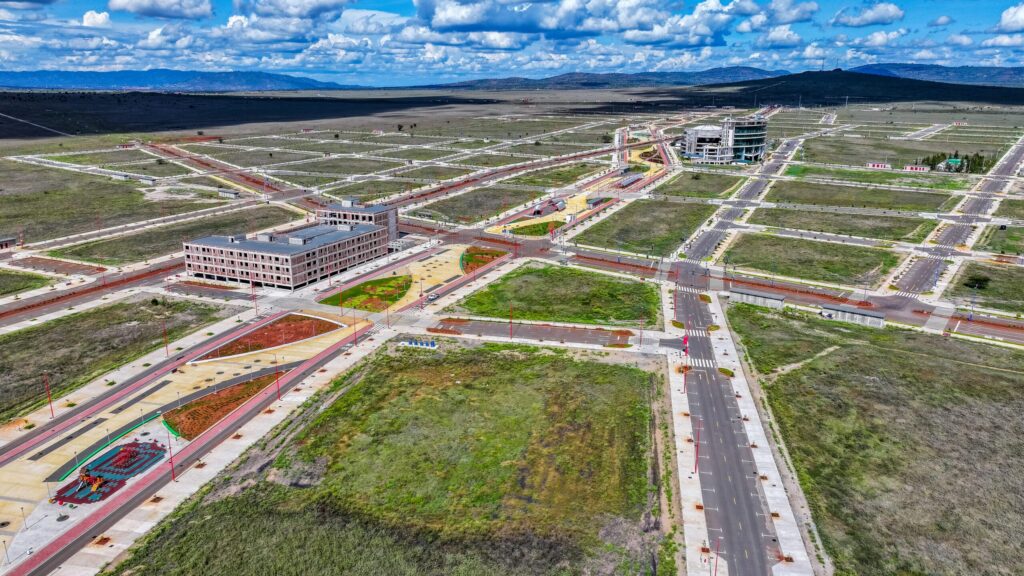
Despite the financial pressures, construction milestones continued accumulating across the city. Completed buildings doubled from nine to 17, with another 26 under construction. Smart poles increased from 81 to 141, while the Intelligent Operations Centre reached full completion.
Utility infrastructure also expanded, with wastewater reclamation utilisation rising from 3,600 to 6,000 cubic metres daily and water treatment capacity increasing from 6,200 to 10,000 cubic metres. Power consumption grew from 5MW to 6MW following the commissioning of the 66kV substation.
Environmental and academic projects also advanced. Trees planted rose from 44,500 to 118,200, the Kenya Advanced Institute of Science and Technology (KAIST) reached full completion, and Riara University Phase I stood at 97% completion.
Still, the Auditor-General’s findings cast a shadow over the progress narrative. All eight unresolved audit issues from the previous year remain outstanding, while recurrent expenses amounting to KSh32.49 million were improperly charged to the development budget.
Trade payables also include KSh92.85 million in pending obligations dating back to the 2022/23 and 2023/24 financial years, contrary to financial regulations. In addition, the Staff Mortgage Scheme Fund has reportedly never prepared financial statements since its establishment.
The stalled conference facility remains perhaps the clearest symbol of Konza’s execution challenges. After five contract extensions, the project remains stuck at 78% completion.
With much of the physical infrastructure now in place, attention is shifting from construction to commercial viability. The next phase for Konza will no longer be judged by how much concrete is poured, but by whether the city can finally turn ambition into sustainable economic activity.