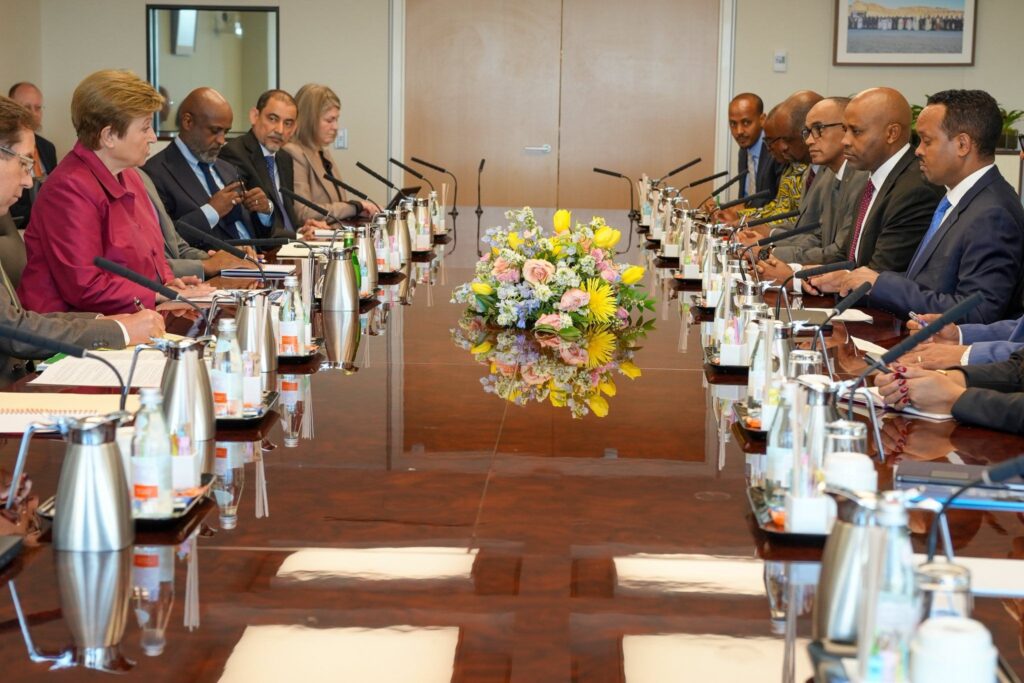
The International Monetary Fund (IMF) has reached a staff-level agreement with Ethiopia under the fifth review of its four-year $3.4 billion Extended Credit Facility programme, paving the way for the release of $468 million once the IMF Executive Board grants final approval.
The latest disbursement will increase total funding received under the programme to $2.65 billion, leaving approximately $750 million yet to be released from the facility that was approved in July 2024.
According to the IMF, Ethiopia’s economy has remained relatively resilient despite global uncertainties. However, the Fund cautioned that external shocks, particularly the ongoing conflict in the Middle East, could pose risks to the country’s economic outlook. While disruptions to trade, temporary fuel shortages, and higher fuel and fertiliser import costs have so far had a limited impact on growth and inflation, a prolonged crisis could necessitate stricter economic policy measures.
Ethiopia’s economy is projected to expand by 9.3% in the 2025/26 financial year, slightly above the 9.2% recorded previously. Inflation is expected to ease significantly to 11.9%, down from 26.6% in the 2023/24 fiscal year. Foreign exchange reserves stood at $4.7 billion as of June 2025, equivalent to about 2.3 months of import cover. Meanwhile, tax revenues jumped by 80% in the 2024/25 fiscal year, supported by foreign exchange reforms and the removal of VAT exemptions.
Also Read: Sakaja Suspends Nairobi Planning Chief Analo After EACC Raid, Orders Reforms
On debt restructuring, Ethiopia has made notable progress with official bilateral creditors. The country secured a debt treatment agreement with China in April 2026, following a similar arrangement with France in February 2026 and a memorandum of understanding with the Official Creditor Committee in July 2025. Together, these agreements cover roughly $8.4 billion in public debt and are expected to provide around $2.5 billion in debt service relief between 2023 and 2028.
However, negotiations with private creditors have hit a dead end. Discussions with an Ad Hoc Committee representing holders of Ethiopia’s defaulted $1 billion Eurobond broke down on May 27 after weeks of negotiations failed to produce a settlement.
A tentative agreement reached in January 2026, which included a 15% reduction in principal and the issuance of new bonds, was later rejected by official creditors who argued it did not meet debt treatment comparability requirements. Following the collapse of the talks, Eurobond holders have signalled they may pursue legal action against the Ethiopian government.