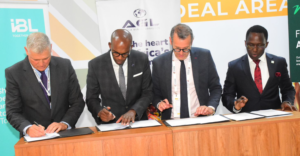
Kenya’s push to expand geothermal generation has gained fresh momentum after the African Development Bank approved a US$16.5 million loan to support the development of a new 35-megawatt power plant at the Menengai geothermal field near Nakuru.
The funding will be directed to the OrPower Twenty-Two (OTTL) project, which will become the third commercial geothermal plant at Menengai. Once operational, the facility will raise installed capacity in the field’s first development phase to 105 MW.
Menengai already hosts two other 35 MW plants that are either operational or nearing completion, including a facility developed by Sosian Energy and another backed by Globeleq, which remains under construction with separate development finance backing.
Commenting on the project, AfDB Energy Financial Solutions, Policy and Regulations Director Wale Shonibare said the Menengai approach highlights the effectiveness of public–private partnerships, where government-led resource development creates the conditions for private investment in power generation.
The AfDB loan forms part of a wider financing package expected to total about US$64 million in debt, against an overall project cost estimated at approximately US$92 million.
Despite Kenya’s increasingly renewable energy mix, electricity costs remain a burden for both industry and households. The new plant is expected to deliver power to the national grid at one of the lowest available tariffs, helping reduce reliance on diesel generation and imported electricity from Ethiopia, particularly during periods of hydropower shortfalls or peak demand.
OTTL Director Qi Jingwen said support from international financial institutions would enable deeper participation in the development of green energy projects across Africa.
OrPower Twenty-Two is owned by Kaishan Group, a Chinese industrial firm specialising in geothermal technology. The plant is expected to produce around 300 gigawatt-hours of electricity annually while avoiding an estimated 1.9 million tonnes of carbon emissions.
Kenya’s Geothermal Strategy
The Menengai geothermal field is owned and managed by the state-run Geothermal Development Company, which undertook the high-risk and capital-intensive exploration and steam development using public funds, including financing from multilateral lenders.
Also Read: Gov’t Re-enters Market With KSh 50 Billion February Bond Reopening
Private independent power producers then construct and operate power plants on the field, purchasing steam from GDC under long-term supply agreements and selling electricity to Kenya Power through 25-year power purchase contracts.
This model has become central to Kenya’s geothermal expansion, allowing the State to absorb early-stage risk while drawing private capital into power generation.
Geothermal energy already underpins Kenya’s base load electricity supply, with installed capacity standing at about 940 MW. This makes Kenya the largest geothermal producer in Africa and one of the leading producers globally.
Under its long-term energy and climate strategy, the government aims to increase geothermal capacity to more than 1.8 gigawatts by 2030.