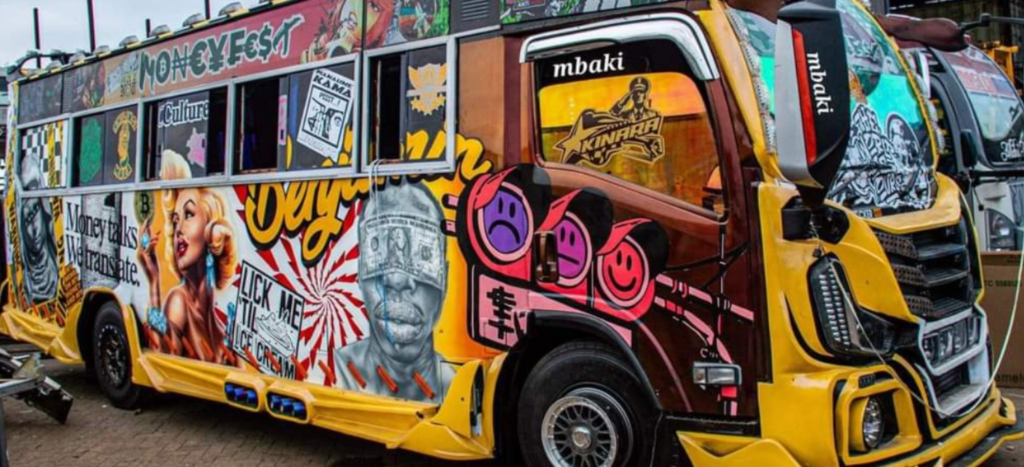
The High Court Wednesday dismissed a constitutional petition challenging the National Transport and Safety Authority (NTSA) directive requiring public service vehicles (PSVs) to remove graffiti, decorative artwork, and tinted windows, dealing a major blow to matatu operators defending Kenya’s popular nganya culture.
In a judgement delivered on Wednesday, Justice Bahati Mwamuye upheld the legality of the May 2025 enforcement notice issued by NTSA, ruling that the directive was lawful and necessary to promote road safety and compliance in the public transport sector.
The petition had been filed by Michael Makubo, who argued that the directive unfairly targeted matatu operators and threatened nganya culture — a distinct urban transport identity known for colourful graffiti, neon lighting, tinted windows, loud entertainment systems, and customised interiors.
Makubo claimed the directive violated constitutional protections, was introduced without adequate public participation, and discriminated against operators who rely on artistic vehicle modifications as part of their commercial appeal.
However, Justice Mwamuye found that the petitioner had failed to prove any violation of constitutional rights, either personally or on behalf of the group he claimed to represent.
The judge held that restrictions on vehicle modifications were justified under Article 24 of the Constitution, which permits limitation of rights where public safety is involved.
He noted that the government’s responsibility to ensure road safety outweighed claims that decorated PSVs were protected forms of artistic and cultural expression.
The court heard that NTSA had directed operators of PSVs fitted with graffiti, dark tinted windows, and similar modifications to remove them or face enforcement action.
NTSA defended the notice, stating that the move was meant to improve passenger and law enforcement visibility, enhance safety on the roads, and ensure uniform standards across the PSV sector.
Justice Mwamuye agreed, ruling that the notice was not a new law but merely an administrative reminder of obligations already provided for under existing transport regulations.
He also dismissed claims of unfair administrative action, saying the directive did not violate legitimate expectations or constitutional safeguards.
On allegations of discrimination, the court found no sufficient evidence showing that operators associated with nganya culture had been unfairly singled out.
Although the petition had been framed as a public interest case aimed at protecting artistic and cultural expression within the matatu industry, the judge ruled that such preferences could not override statutory safety requirements.
The court therefore declined to grant all the declarations and orders sought by the petitioner and upheld NTSA’s enforcement action in full.
Following the judgment, the petitioner’s lawyer made an oral application seeking 14 days to file an appeal and requested temporary preservation of the existing position.
State lawyers opposed the request, arguing that the court had become functus officio after delivering judgment and could not suspend its own final orders.
Justice Mwamuye granted limited temporary relief, saying a short transition period was necessary to allow compliance and preserve the petitioner’s right to approach the appellate court.
He reinstated only the substance of the earlier interim orders for a short period, while making it clear that the main judgment upholding NTSA’s directive remains fully in force.
The temporary orders took effect immediately and will automatically lapse on May 17, 2026, unless a higher court issues fresh orders staying the judgment pending appeal.
READ ALSO;
Special Teams Deployed On The Mwingi-Garissa Highway After Chaos Disrupt Transport

