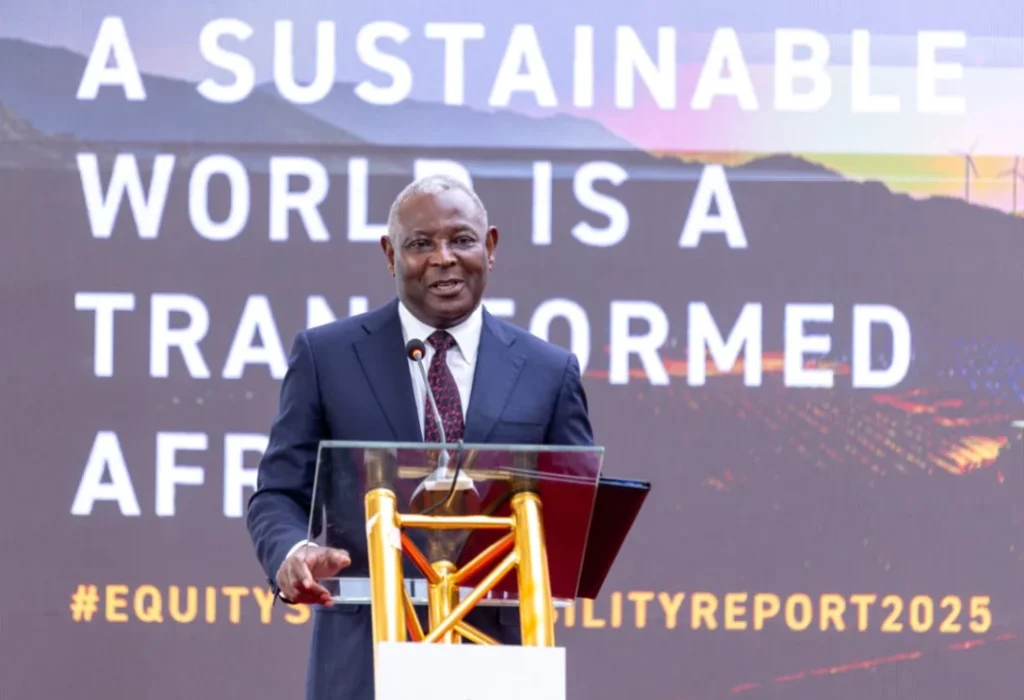
Equity Group Holdings Plc invested a record Sh99.5 billion ($771 million) in social impact and sustainability initiatives in 2025, as the financial services group stepped up efforts to expand financial inclusion, support businesses and strengthen climate resilience across its regional markets.
The investment, disclosed in the Group’s 2025 Sustainability Report released in Nairobi on Thursday, covered interventions in enterprise development, education, healthcare, agriculture, social protection and environmental conservation.
The report, themed “A Sustainable World is a Transformed Africa,” highlights the Group’s growing integration of sustainability into its business strategy, governance, risk management and operations through its Tri-Engine Model.
A major component of the investment was sustainable finance, with more than Sh26 billion deployed to support climate-aligned projects during the year.
The Group also recorded more than 47,000 climate-related transactions under the International Finance Corporation’s Climate Adaptation Finance Initiative, distributed 75,855 clean-energy products and planted 9.1 million trees.
The latest tree-planting exercise brought Equity’s cumulative total to 44.6 million trees, surpassing its target of 35 million.
Equity Group Managing Director and Chief Executive Officer James Mwangi said the performance demonstrated that commercial success and sustainable development could reinforce each other.
“Our 2025 performance demonstrates that commercial success and sustainable development are not competing priorities, but mutually reinforcing drivers of long-term prosperity,” Mwangi said.
He added that the Group would continue directing investments towards building resilient communities, supporting enterprises and protecting natural resources.
The report also highlights the Group’s growing role in financing micro, small and medium-sized enterprises (MSMEs), with Sh404 billion ($3.11 billion) disbursed to businesses during the year.
Through the Equity Group Foundation, the lender has cumulatively trained 962,924 entrepreneurs in business development and 2.49 million women and young people in financial education.
Local suppliers accounted for 90 per cent of the Group’s procurement expenditure, amounting to Sh47.59 billion in 2025.
Agriculture also remained a key investment area, with 622,525 smallholder and medium-sized farmers reached through climate-smart financing, training and value-chain interventions aimed at improving productivity and strengthening food security.
Under its education pillar, Equity supported 60,009 scholars, including 29,515 university students, 4,039 TVET students and 1,115 global scholars.
The Group also facilitated 9,772 paid internships to improve young people’s transition from education into employment.
Through its Equity Leaders Programme, 415 innovators secured employment after completing a 12-month technology apprenticeship programme.
In healthcare, Equity Afya expanded its network to 150 outpatient medical centres across Kenya and the Democratic Republic of Congo, recording more than 4.62 million cumulative patient visits.
Social protection programmes reached 5.94 million people, with Sh173.5 billion disbursed through cash transfers.
The Group also extended financial support to refugees, providing Sh57.9 million in loans to 115 beneficiaries, while 772 refugees received training to improve their economic participation.
German Ambassador to Kenya Sebastian Groth said partnerships between governments, private-sector players and development institutions were critical to mobilising capital for sustainable development.
He said development cooperation was increasingly shifting from traditional aid towards investments that mobilise private-sector financing, particularly in renewable energy, local value addition and climate finance.
Nasra Nanda, Built Environment Lead at the Executive Office of the President, urged financial institutions to incorporate environmental resilience into construction financing and investment decisions.
She said sustainable construction should prioritise affordable, safe and resilient buildings while supporting businesses and skills development in the built environment.
Workforce and governance
The report shows that Equity Group’s workforce grew to 13,370 employees in 2025, with staff training reaching 989,152 hours, equivalent to an average of 74 hours per employee, up from 45 hours in 2024.
The number of employees with disabilities increased to 67 from 54, while net employee turnover declined to 10.6 per cent from 11.1 per cent.
The Group also continued strengthening environmental, social and governance risk management through enhanced screening of lending activities, climate scenario analysis and stress testing.
It is also preparing to implement the IFRS S1 and S2 sustainability disclosure standards.
Equity Bank sets ambitious 2030 targets
Separately, Equity Bank Kenya published its inaugural Sustainable Development Impact Disclosure, setting out seven impact commitments aligned with the United Nations Sustainable Development Goals.
The disclosure establishes 2030 targets that include increasing the share of its loan book allocated to food and agriculture to 30 per cent, MSMEs to 65 per cent and manufacturing to 15 per cent.
The bank also plans to double the Equity Afya medical network from 150 to 300 clinics.
The report indicates that MSMEs accounted for 56.6 per cent of the bank’s loan book in 2025, up from 50.1 per cent in 2023, while lending to women increased to 23.9 per cent from 18 per cent over the same period.
Equity Group operates across Kenya, Uganda, Tanzania, Rwanda, South Sudan and the Democratic Republic of Congo, with a representative office in Ethiopia.
The latest sustainability report reinforces the Group’s strategy of positioning financial services as a tool for economic transformation, social inclusion and environmental protection across Africa.