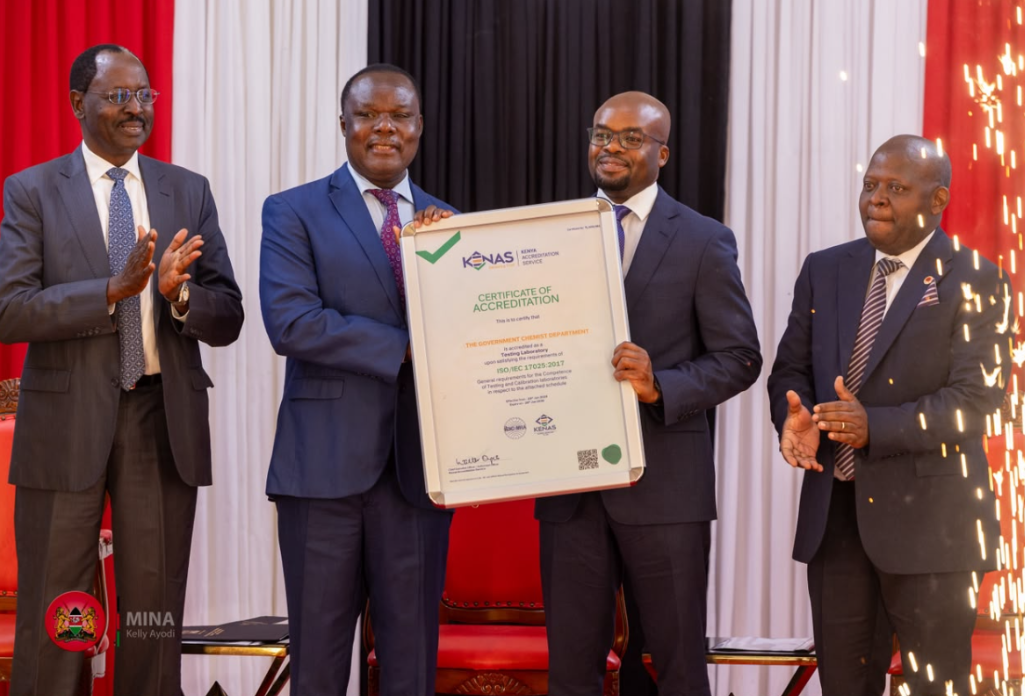
The Government Chemist Department formally received its ISO/IEC 17025 Testing Laboratory Accreditation Certificate from the Kenya Accreditation Service (KENAS), marking a major milestone in strengthening confidence in the scientific evidence used in criminal investigations, court proceedings, public health decisions and regulatory enforcement.
The Department attained the accreditation in June 2026 after undergoing an assessment process lasting nearly three years. The accreditation confirms that laboratory services undertaken within the accredited scope meet internationally recognised requirements for technical competence, quality and impartiality.
Speaking during the presentation ceremony, Principal Secretary for Internal Security and National Administration Dr. Raymond Omollo, congratulated the Government Chemist’s leadership and staff, noting that the Department’s work extends beyond supporting the National Police Service to serving government institutions, private organisations and citizens seeking scientifically reliable answers.
Dr. Omollo observed that Government Chemist experts are sometimes required to defend their reports in court and may be questioned about whether their laboratory is accredited. He said the certification would strengthen their response to such questions and enhance confidence in the scientific evidence presented before courts.
“The official presentation of the ISO/IEC 17025 Testing Laboratory Accreditation Certificate by KENAS affirms that scientific work undertaken by one of Kenya’s most important national laboratories has been independently assessed against internationally recognised requirements for technical competence, quality and impartiality,” Dr. Omollo said.
He said the Government Chemist Department, which falls under the State Department for Internal Security and National Administration, occupies a unique position as Kenya’s central institution for forensic science and analytical laboratory services.
Its scientific work supports the administration of justice, public health, environmental protection, national security, consumer protection and regulatory
enforcement.
The Department also serves as Kenya’s National Authority for the implementation of the Chemical Weapons Convention and as a focal point within the country’s Chemical, Biological, Radiological and Nuclear coordination framework.
Dr. Omollo said forensic science forms part of the foundation upon which investigations by the National Police Service, the Directorate of Criminal Investigations and the Office of the Director of Public Prosecutions are built.
“Forensic examinations can determine whether an investigation moves forward, whether evidence can be relied upon and, ultimately, whether justice can be done.
This accreditation therefore strengthens the credibility and reliability of scientific evidence placed before our courts,” he said.
The accreditation will also give the Judiciary, the Office of the Attorney-General and oversight institutions greater confidence in expert scientific testimony and the integrity of evidence relied upon in legal proceedings.

He noted that reliable laboratory testing was critical to public health, particularly in cases involving suspected poisoning, narcotic drugs and questions concerning the safety or composition of food, drinks, medicines, agricultural inputs and industrial chemicals.
He cautioned that the presentation of the certificate did not mark the end of the accreditation journey.
Although the accreditation is valid for four years, the Department must continuously maintain the required standards because the accreditation can be withdrawn if it fails to comply with the prescribed requirements.
Dr. Omollo called on government institutions to regard the Government Chemist Department as a shared national scientific capability instead of developing isolated or duplicative analytical facilities.
He said greater collaboration would enable institutions to share expertise, technology, data and infrastructure, ensure efficient deployment of public resources and give Kenyans better value for money.
“Our responsibility now is to ensure that the benefits of this accreditation go beyond the Government Chemist Department and are felt throughout our institutions and, ultimately, by the Kenyan people whom we all serve,” he said.
“I call upon each and every one of us to deepen cooperation with the Government Chemist Department so that credible science continues to strengthen public
confidence in Government.”
He further challenged the Department to expand its mandate beyond receiving samples and issuing reports by developing into a national centre of scientific expertise and research.
“This accreditation is not an end in itself. The real test begins with what we have done today—the presentation of the certificate. The Government Chemist should not only be a laboratory where samples arrive and reports leave.
It should increasingly become a national centre of scientific expertise and contribute to research,” Dr. Omollo said.
He called for continued investment in human-resource development to enable the Department to anticipate emerging scientific threats and undertake responsibilities beyond its traditional laboratory functions.
Dr. Omollo commended the scientists, analysts, technologists, quality officers, administrators and other members of staff whose work contributed to the
achievement, saying the certificate belonged to the entire Government Chemist team.
“It demonstrates your commitment to scientific excellence, quality public service and internationally recognised standards,” he said.
The Principal Secretary for the State Department for Industry, Dr. Juma Mukhwana, said the accreditation confirmed that the Government Chemist had appropriate systems, equipment, chemicals and, most importantly, qualified and competent personnel to produce reliable results.
He emphasised that even the best laboratory equipment and chemicals could not guarantee accurate results without skilled personnel, describing the accreditation as global best practice and a major milestone for Kenya’s national quality infrastructure. “Today is more than a ceremony. It is a statement about trust, justice, science and the protection of the Kenyan public,” Dr. Mukhwana said.
He noted that a sample submitted to the Government Chemist may represent a victim seeking justice, a family waiting for answers, a police investigation dependent on scientific evidence or a court seeking to establish the truth.
“Laboratory results can change a life. They can determine the direction of an investigation, strengthen a prosecution, protect the innocent and protect the public. That is why quality cannot be optional. Quality is a must,” he said.
The accreditation is expected to strengthen public confidence in the Government Chemist Department and enhance its ability to provide credible, timely and scientifically defensible services in support of justice, public health, national security and regulatory enforcement.
Present during the ceremony were the Principal Secretary for the State Department for Industry, Dr. Juma Mukhwana, the Chief Executive Officer of the Kenya
Accreditation Service, Dr. Walter Ongeti, the Government Chemist, William Munyoki and heads of departments.
READ ALOS;