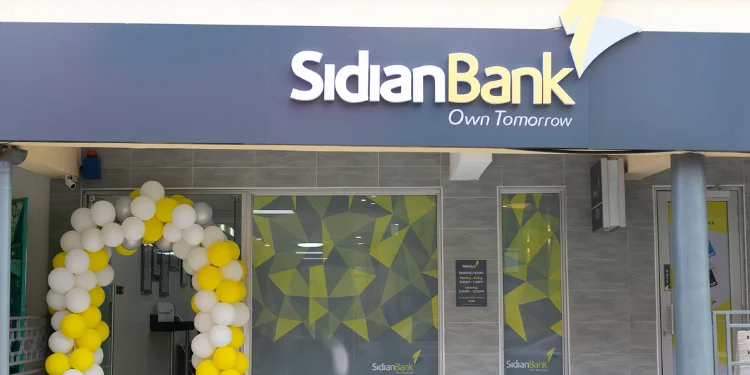
Mid-tier lender Sidian Bank recorded a profit after tax of KSh 607.03 million for the quarter ended 31 March 2026, a 9.0% increase from KSh 556.94 million in the same period the previous year, extending its recent run of financial recovery within Kenya’s banking sector.
Net interest income more than doubled to KSh 1.61 billion from KSh 736.58 million, supported by a 61.9% rise in total interest income to KSh 2.88 billion. The performance was largely driven by returns from a growing government securities portfolio, which has become a key pillar of the bank’s balance sheet.
Interest expenses increased by 21.8% to KSh 1.27 billion, a slower pace that helped contain funding costs despite a broader expansion in deposits.
The results mark the first quarterly statement under incoming CEO John Okulo, who assumed office on 1 May 2026 after joining from KCB Bank Kenya. He succeeds Chege Thumbi, who is set to retire at the end of June after a nine-year tenure that saw the institution evolve from a small Tier 3 lender into a mid-sized bank with assets nearing KSh 94 billion.
Total assets rose by 38.1% to KSh 94.08 billion, while customer deposits surged 47.6% to KSh 74.16 billion. Over a longer horizon, deposits have expanded from KSh 16.52 billion in 2019 to more than KSh 74 billion in 2026, reflecting a sustained and accelerated build-up in funding capacity.
A significant driver of this growth has been public sector banking mandates. The Nairobi County Government appointed Nairobi County Government as its principal banker in October 2025, shifting key revenue streams, donor funds, and health facility collections away from rival institutions.
Also Read: COMESA Opens Competition Inquiry Into Nation Media Acquisition Deal
The bank also handles inflows for the Social Health Authority, the housing levy system, Kenya Railways, and KEMSA. In March 2026, Nairobi MCAs approved a KSh 1.7 billion monthly payroll overdraft facility, further strengthening the county’s financial dependence on the lender.
Much of the resulting liquidity has been directed into Treasury bills and bonds rather than expanded lending activity. Net loans and advances increased modestly by 11.9% to KSh 29.38 billion, while investment securities stood at KSh 9.94 billion.
Asset quality showed mild improvement, with gross non-performing loans easing to KSh 8.25 billion from KSh 8.65 billion, while net NPL exposure dropped significantly to KSh 77.75 million from KSh 137.57 million.
Non-interest income fell sharply by 45.9% to KSh 557.34 million, largely due to a steep decline in “other income”, which had been unusually high in the previous year. Other fee lines, however, continued to grow, pointing to a one-off boost in Q1 2025 rather than a structural downturn.
Capital buffers strengthened after core capital climbed to KSh 11.77 billion, lifting the core capital adequacy ratio to 19.6% from 12.2% a year earlier, following a KSh 3 billion rights issue completed in early 2026. Liquidity remained exceptionally strong at 76.9%, well above the statutory minimum of 20%.


