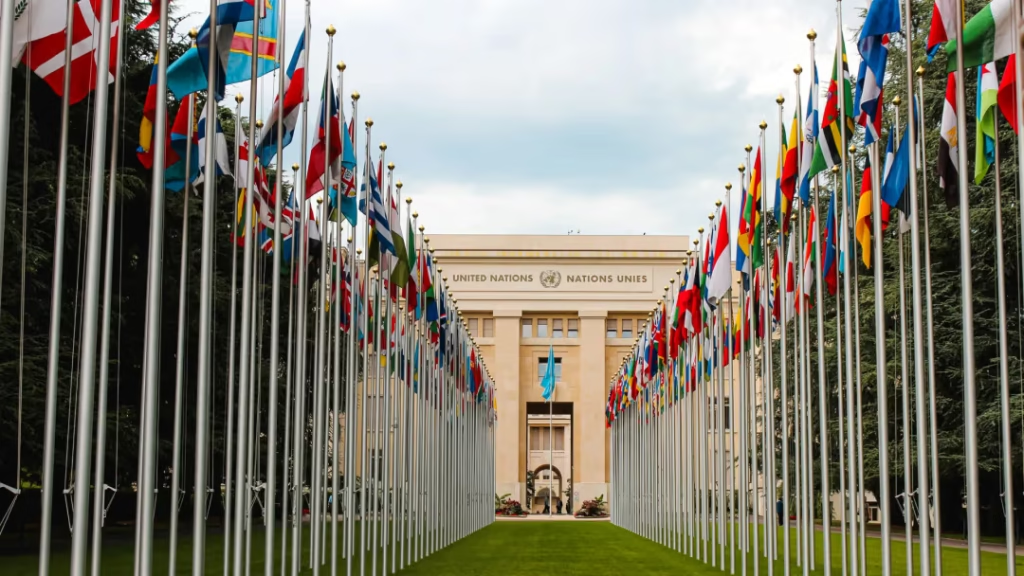
The United Nations(UN) has formally set in motion the process of choosing its next Secretary-General, who will take over from António Guterres in 2027.
The selection process enters a visible phase this week, with candidates expected to take part in interactive dialogues. These sessions will allow them to present their vision, share professional backgrounds, and disclose campaign financing details to member states and civil society organisations.
So far, four contenders have emerged: former Chilean president Michelle Bachelet, current UNCTAD chief Rebeca Grynspan, Argentine diplomat Rafael Grossi, and former Senegalese president Macky Sall. Sall’s bid has stirred debate, largely due to longstanding conventions around regional rotation and growing calls for the organisation’s first female leader.
The process, which quietly began in November last year, is expected to stretch over several months. Ultimately, the UN Security Council must recommend a candidate before the UN General Assembly makes the final appointment. The structure grants veto power to the five permanent members of the Security Council, a factor that often shapes outcomes behind closed doors.
By tradition, no Secretary-General can come from those five permanent powers, and the role rotates across global regions. While there is no formal term limit, incumbents since 1961 have typically served two five-year terms, with the notable exception of Boutros Boutros-Ghali, whose second term was blocked by the United States. He was succeeded by Kofi Annan, keeping the position within Africa until 2006.
Also Read: Kenya’s Power Grid Stretched Thin as Demand Surges and Capacity Stalls
Efforts to make the process more transparent have had limited success. Although public candidate debates were introduced in 2016, the decisive deliberations within the Security Council remain largely opaque.
Why Macky Sall’s Bid Has Sparked Friction
Sall’s candidacy has proved contentious chiefly because the rotation principle points to Latin America as the next region expected to produce the Secretary-General. He is also the only current candidate outside that bloc.
Complicating matters further, Sall lacks formal backing from the African Union and even from his home country, Senegal. The African Union Commission indicated that at least 20 member states declined to support his nomination, citing procedural concerns and the pace at which it was advanced.
Burundi, which currently holds the AU chair, put forward Sall’s name and is reportedly lobbying for him with support from countries including France, a permanent member of the Security Council. The timing of the nomination, coming shortly after Burundi assumed the AU’s rotating leadership, has unsettled some diplomats wary of straining ties between African and Latin American blocs.