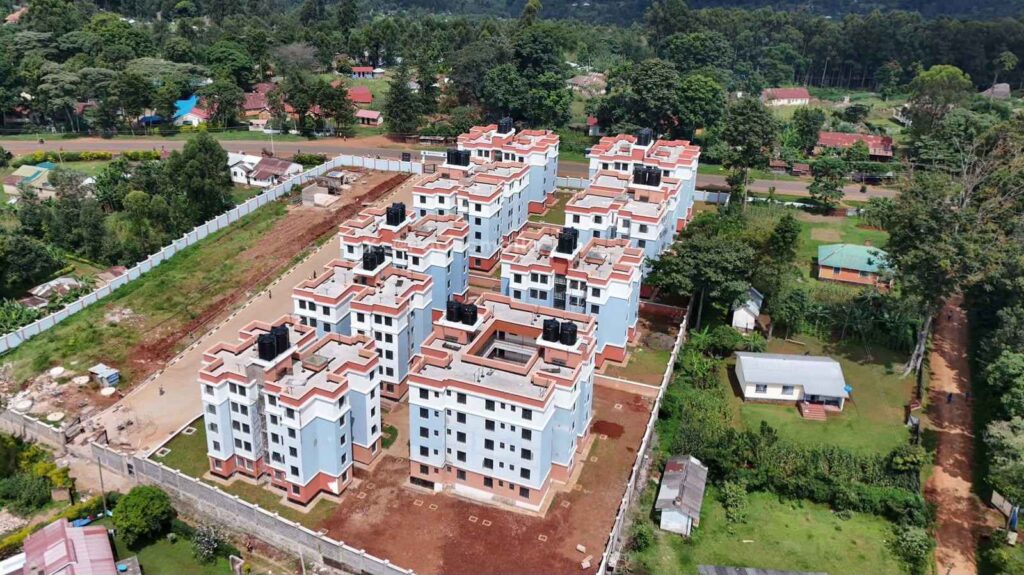
Kenya’s Affordable Housing Programme (AHP) has completed 10,107 housing units since September 2022, with another 196,846 units currently under construction, according to the State Department for Housing and Urban Development.
The department said the programme has a combined 282,551 completed and ongoing units, covering affordable homes, institutional and staff housing, as well as student accommodation.
Since its launch, the programme has created more than 640,442 jobs, with the government projecting that employment opportunities will exceed one million by the time the initiative is fully implemented.
The programme also includes specialised housing and support facilities for disciplined forces, civil servants and other public sector employees. Some of the staff housing units are being developed close to duty stations and allocated to specific groups to improve access to affordable accommodation.
The department said the specialised facilities, including barracks, hostels and operational infrastructure, are intended to improve staff welfare and morale, strengthen operational readiness and support recruitment and retention within the public service.
Student Housing Expansion
Student accommodation has also become a significant component of the programme.
The government has awarded 134,907 student beds that are currently under construction, equivalent to approximately 38,545 housing units.
Overall, 177,686 student beds have been packaged for universities and colleges as part of efforts to address the shortage of affordable accommodation for students.
Youth, Women and Local Employment
The programme has also provided employment opportunities for young people, women and residents of project-hosting counties.
A total of 5,211 graduate interns have been shortlisted and onboarded across various AHP projects, alongside 70 rehabilitated youths and other low-skilled workers.
Women make up between 21 per cent and 30 per cent of the workforce, depending on the construction site. Their participation is particularly prominent in finishing works, administration, community contracting and emerging technical trades.
Persons living with disabilities account for about five per cent of workers engaged in AHP projects.
The State Department said recruitment has prioritised fairness and local participation, with between 47 per cent and 60 per cent of workers at individual project sites being drawn from the respective counties.
MSMEs and Jua Kali Businesses
Small businesses and Jua Kali enterprises have also benefited from the housing programme, with KSh11 billion specifically allocated to support MSMEs and informal-sector businesses involved in affordable housing and market projects.
Local artisans provide a range of construction-related products and services, including prefabricated steel doors and windows, balustrades, curtain rods and landscaping solutions.
Jua Kali artisans account for approximately 17.5 per cent of reported labour under the programme and supply items such as steel doors, windows, metal fittings, timber products, cabro paving blocks and furniture.
Also Read: KRA Integrates eTIMS With Government Payment System
Their participation has also been supported through the Recognition of Prior Learning programme, which has certified more than 2,540 artisans, including 231 women.
Climate-Resilient Housing
The government has incorporated climate resilience into the design of affordable housing developments, with projects featuring measures aimed at managing flooding and promoting green infrastructure.
These include gabions for controlling floodwaters, boundary walls and other green infrastructure designed to strengthen developments against climate-related risks.
The State Department said a further 10,000 housing units are planned along sections of the rehabilitated Nairobi River under the Nairobi River Regeneration Programme.
Meanwhile, about 44,000 young people are participating in Climate Worx activities, including river clean-ups, tree planting and sustainable waste management along the river’s riparian corridor.