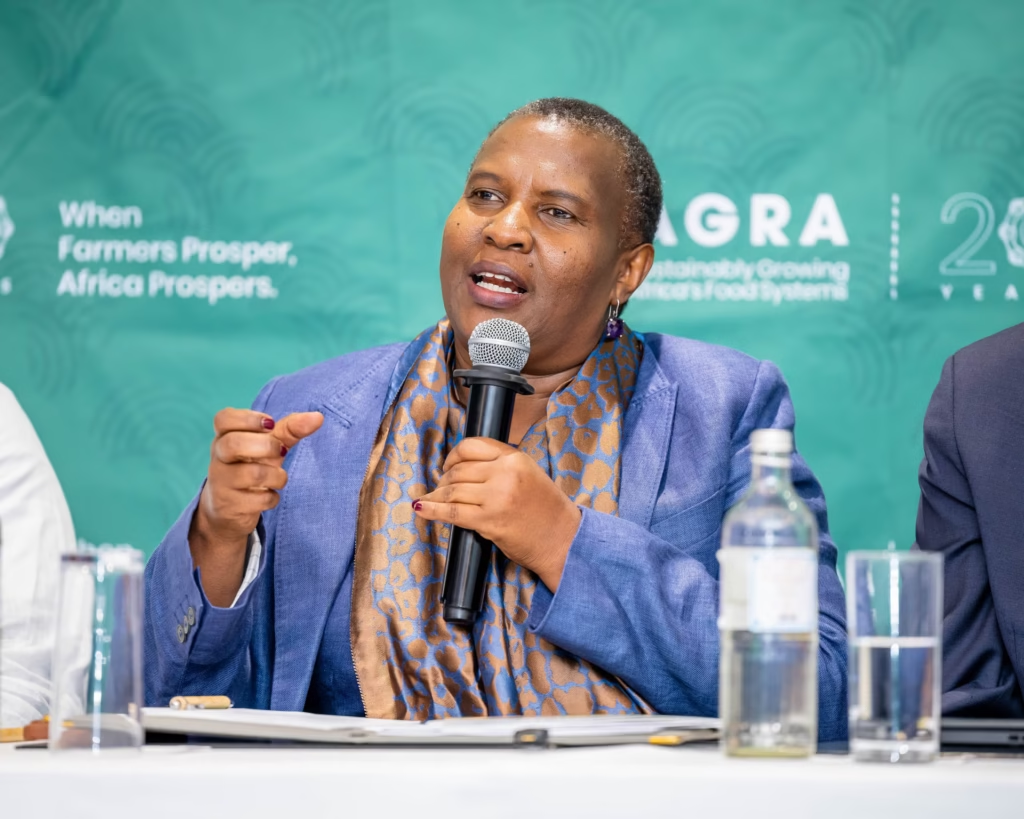
Africa’s agricultural sector has recorded notable progress over the past two decades, but increased production has not translated into adequate incomes and improved livelihoods for millions of farmers, according to a new report by the Alliance for a Green Revolution in Africa (AGRA).
AGRA’s 20-year Impact, Learning and Foresight Report shows that farmer incomes have doubled since 2005, while cereal yields have risen by about 40 per cent and agricultural output has nearly doubled in real terms.
Agriculture’s contribution to economic growth has also strengthened, with Gross Value Added growth increasing from roughly 2.3 per cent to almost 4 per cent, underscoring the sector’s growing importance to Africa’s economies.
However, AGRA says the gains have been uneven and have yet to deliver the structural transformation needed to make agriculture a dependable route out of poverty and towards prosperity.
“Twenty years of evidence show that Africa’s agrifood sector can move when the conditions are right. The task now is to turn that progress into income, resilience, dignity and opportunity for farmers,” said AGRA President Alice Ruhweza.
The report argues that Africa’s agricultural challenge is no longer simply about producing more food. The priority is ensuring farmers capture a larger share of the economic value generated from their produce.
Despite improvements in productivity, significant gaps remain, while hunger has increased in some parts of the continent. Many farmers continue to struggle to turn higher production into stable and sustainable incomes.
AGRA identifies three interconnected challenges behind the problem: the productivity trap, the value trap and the capability trap.
The productivity trap limits farmers’ ability to produce consistently and cope with disruptions, including climate change. The value trap occurs when increased production fails to generate corresponding gains in incomes, employment, processing, trade and competitiveness.
The capability trap stems from weaknesses in institutions, financing, data, coordination and accountability, making it difficult to implement and sustain agricultural policies effectively.
According to AGRA, tackling any one of these challenges in isolation will not be enough.
Farmers require dependable access to inputs, technology and agricultural knowledge, but these must be matched with functioning markets, processing facilities, infrastructure and financing that enable them to earn more from agricultural value chains.
“The question for the next decade is not only what Africa can produce, but whether the systems around farmers allow them to prosper,” said AGRA Board Chair H.E. Hailemariam Dessalegn.
Strengthening Africa’s Agricultural Ecosystem
Over the past 20 years, AGRA and its partners have worked to strengthen various parts of Africa’s agricultural ecosystem, including seed companies, agro-dealers, extension services, research institutions and government capacity.
AGRA Vice President for Technical Expertise Jonathan Faid said much of the organisation’s investment had been directed towards African businesses and institutions rather than multinational corporations.
The report says AGRA has supported 118 seed companies and more than 650 improved seed varieties, while helping establish networks comprising more than 25,000 agro-dealers and 33,000 community extensionists.
The organisation has also trained five million farmers in soil health and climate-smart agriculture and supported nearly 800 scientists. In addition, AGRA says its efforts have helped mobilise about US$691 million for national agricultural investment plans.
Also Read: Kakuzi Breaks Ground For New Blueberry Production Orchards
Faid said the goal was to develop systems that give farmers greater opportunities to expand their businesses while creating room for African small and medium-sized enterprises to grow.
He noted, however, that AGRA’s interventions had been concentrated in particular areas rather than implemented uniformly across entire countries.
Turning Production Into Prosperity
The report comes as African governments seek to boost agricultural production, reduce dependence on food imports, create rural jobs and strengthen communities against the effects of climate change.
AGRA says agriculture can no longer be viewed as the sole responsibility of agriculture ministries and farmers.
Policies and investment in finance, trade, water, energy, infrastructure, health, nutrition, education, climate, science and industry all have a bearing on whether farmers can operate profitable businesses.
The organisation is consequently calling for closer cooperation between governments, farmers, businesses, financial institutions, researchers, civil society organisations and development partners.
AGRA warns that when farmers cannot produce reliably, the consequences extend beyond the farm gate. Food prices rise, nutrition deteriorates, import bills increase, employment opportunities decline and young people become less confident in the prospects of rural economies.
By contrast, profitable farmers can drive stronger rural markets, create employment, attract investment and contribute to more resilient communities.