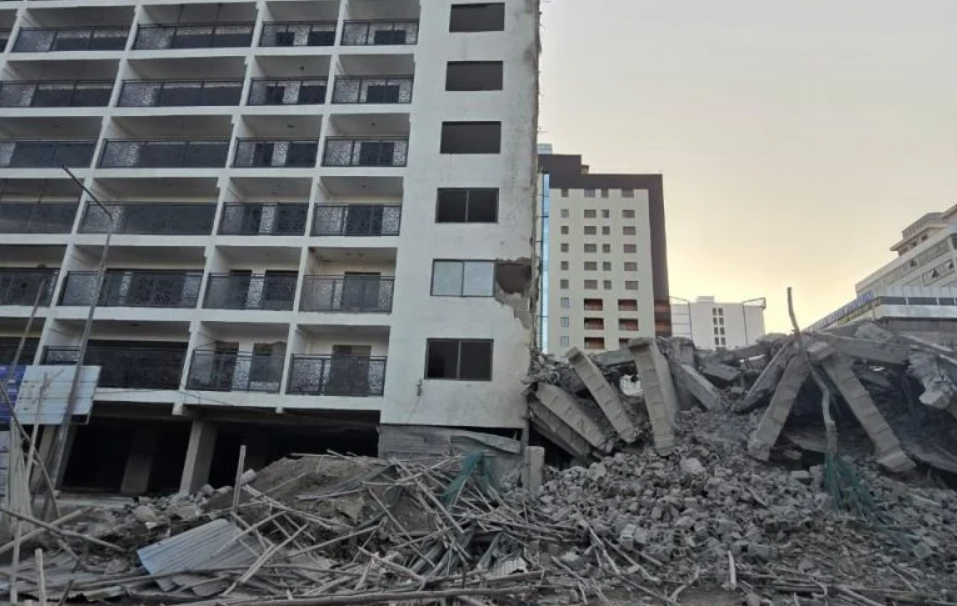
The Director of Public Prosecutions (DPP) approved the prosecution of several individuals following the collapse of Manzil Towers in South C, Nairobi, on January 2, 2026.
The collapse killed two people.
According to the DPP, a review of the investigation file submitted by the Directorate of Criminal Investigations (DCI) found sufficient evidence and a realistic prospect of conviction against a number of suspects linked to the tragedy.
Among those approved for prosecution is suspended director of urban planning Patrick Analo Akivaga, who will face charges of abuse of office and neglect of official duty under the Penal Code.
Investigators linked the charges to findings concerning the approval, oversight and regulatory processes surrounding the construction project before its collapse.
The DPP has also approved charges against other public officials, developers and professionals connected to the project.
The offences include manslaughter, abuse of office, neglect of official duty, making and uttering false documents, and commencing a project without an Environmental Impact Assessment licence.
The prosecution authority said the decision was made in accordance with Article 157 of the Constitution, the Office of the Director of Public Prosecutions Act and the Decision to Charge Guidelines, based on evidence presented by investigators.
The accused persons are expected to be arraigned in court to answer to the charges.
The Office of the Director of Public Prosecutions reaffirmed its commitment to upholding the rule of law, protecting the public interest and ensuring accountability where criminal conduct is established through investigations.
Those to face manslaughter charges include Daniel Alphonse Odhiambo, Gideon Chege Mwangi, Abdishakur Muse Mohamed and Yussuf Mohamed Yussuf.
Those to face abuse of office are Patrick Analo Akivaga, Christopher Naicca, Brenda Nyawana, Alfred Eshitera, Tom Achar, Philomena Wanjui, Wilfred Masinde, Sammy Shileche, Judy Gitau and Patrick Nutunga.
Others are Stephen Mwadere, Kimani Stanely, Micheal Nderitu, Teresia Njoki, Simon Omondi, Ian Lewiso Gichero, Eunice Ngaho, Josephine Nate, Philip Mbithi, Francis Odhiambo, Grace Kiburo, Moses Nyogesa, Larry Ochieng, Davis Mutinda, Joseph Mutua, Dominic Mutegi, Mackline Saitera, Martha Maina , Vivian Adongo, Jassan Njani, Eluid Lemaiyan, Eng. Daniel Alphonse Odhiambo, Arch. Gideon Chege Mwangi, Abdishakur Muse
Mohammedc Yussuf Mohammed Yussuf, Bowen Kwambai Kanda and Abraham Choti Arati.
They will also face charges of neglect of official duty.
Those to face charges of making false documents include Gideon Chege Mwangi, Yussuf Mohamed Yussuf and Abdishakur Muse Mohamed.
They will also face extra charges of uttering a false document and commencing a project without an environmental impact assessment license.
The move came after days of push and pull from stakeholders.
A section of residents in Nairobi’s South C estate had in May issued a seven-day ultimatum to Housing Cabinet Secretary Alice Wahome demanding immediate action and public accountability over the collapse of the illegal 16-storey building.
In a strongly worded letter dated May 11, the residents accused the government of silence and inaction more than five months after the tragedy at Muhoho Avenue in South C involving Plot No. 68/1306.
The residents, through South C Residents Association chairman Abdi Karim Hassan, said repeated calls for investigations and accountability had been ignored despite earlier petitions and public concern over unsafe buildings in the area.
“We write on behalf of residents of South C and the wider Kenyan public to express our profound outrage, disappointment and concern over the continued silence and apparent inaction,” the letter stated.
The association said a petition submitted to the ministry on April 17, 2026 had allegedly not received any response, further fuelling fears that influential individuals linked to illegal developments were being shielded from scrutiny.
“The silence from your Ministry and other enforcement agencies has created the disturbing perception that powerful individuals connected to the illegal developments are being protected at the expense of public safety and justice,” the residents said.
The residents demanded that the ministry publicly communicate actions taken within seven days of receiving the complaint, warning that continued inaction would reinforce perceptions of corruption and negligence within the construction sector.
They also warned that failure to urgently address dangerous structures could expose more residents to risk.
“Every day that passes without action places more lives at risk,” the letter adds.
The association further cautioned that any future building collapse occurring after repeated warnings would place responsibility squarely on government institutions and officials accused of failing to act.
The January collapse sparked renewed debate over enforcement of building regulations in Nairobi, with concerns raised over illegal approvals, weak inspections and corruption within the construction sector.
The residents have staged protests over the incident in vain.
The association further urged authorities to institute criminal proceedings against all parties linked to the project, including the developer, county officials involved in approvals and enforcement, and professional consultants.
The residents also accused enforcement agencies of enabling a “culture of impunity,” alleging that previous enforcement notices issued in 2025 failed to stop the illegal construction.
They claimed some officers faced intimidation, while arrested site agents were quickly released and allowed to resume work.
This comes amid growing concern over building safety across Nairobi, with professionals warning that a number of structures in the city could be structurally unsound.
The Directorate of Criminal Investigations (DCI) attributed delays in concluding the probe to the complexity of the case.
The agency said investigations span the entire lifecycle of the building—from approvals and inspections to construction and structural integrity assessments—and rely on reports from multiple institutions.
READ ALSO;
Kenya On High Alert As Ebola Outbreak Persists In DRC And Uganda