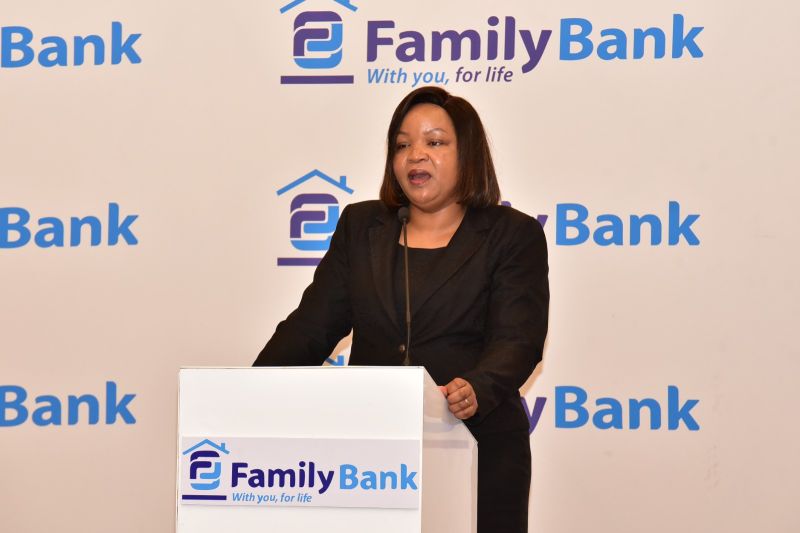
Family Bank PLC’s transition to the Nairobi Securities Exchange places Chief Executive Officer and Managing Director Nancy Njau at the centre of one of the lender’s most significant milestones.
Njau’s journey with the bank spans more than two decades. She joined as a graduate clerk when Family Bank was still operating as a building society and has risen through the ranks to lead the institution into life as a publicly listed company.
Her appointment as CEO in January 2024 came at a pivotal moment, with the bank preparing for a stock market debut. A Sh8 billion private placement completed in 2025 strengthened its capital base ahead of its listing by introduction on the NSE.
The listing also places Njau among the small number of women leading companies quoted on the local bourse.
Speaking during the bell-ringing ceremony in June, she described the listing as the beginning of a new phase rather than the culmination of the bank’s journey.
An accountant by profession, Njau is among the few banking executives in Kenya to reach the top job through internal succession, bringing extensive institutional experience to the role.
Steering Growth
When she assumed leadership, Family Bank operated more than 90 branches nationwide, with a strong presence in SME and retail banking. The lender was expanding its loan portfolio, growing customer deposits, increasing investments in government securities and working to improve profitability.
Njau inherited the task of balancing expansion with sound asset quality, improving operational efficiency and preparing the bank for the heightened governance and disclosure standards that accompany a public listing.
Her early priorities included strengthening capital, delivering more consistent earnings, expanding the customer base and positioning the bank for entry into the capital markets.
Before listing, Family Bank enhanced its governance framework, improved financial reporting standards and reinforced its capital adequacy to meet investor expectations.
Climbing the Ladder
Njau began her career at what was then Family Finance Building Society, working in retail banking across customer service, branch operations and branch supervision as the institution steadily expanded.
The lender, founded by TK Muya in 1984, evolved from a building society into a commercial bank after receiving a banking licence in 2007, paving the way for its eventual stock market debut nearly two decades later.
Her progression through the organisation reflected increasing responsibility.
She became a Branch Manager in 2009 before serving as Senior Manager between 2010 and 2013. She later rose to Regional Manager, overseeing branch performance, lending, deposit mobilisation and operational efficiency across several regions.
In 2017, she was appointed Head of Retail Banking, where she focused on growing the customer base, strengthening products and improving service delivery.
She later headed Strategic Partnerships, leading collaborations with corporates and development partners to broaden the bank’s reach and diversify revenue opportunities.
Between 2020 and mid-2023, Njau served as Chief Officer for Public Sector Banking, overseeing relationships with government institutions and helping grow public-sector deposits.
Also Read: Kenyan Banks Post Record First-Quarter Profits Despite Lower Interest Rates
She was subsequently promoted to Chief Commercial Officer, where she coordinated strategy across the retail, SME and corporate banking businesses before taking over as CEO in January 2024.
Reflecting on her first year in office, Njau described the experience as “running as you learn.”
Family Bank’s Progress
Since Njau became CEO, Family Bank has significantly expanded its balance sheet.
Total assets increased from Sh142.4 billion at the end of 2023 to Sh230.3 billion by the first quarter of 2026. Customer deposits climbed from Sh102.6 billion to Sh151.9 billion over the same period, while net loans and advances rose from Sh86.9 billion to Sh108.4 billion.
The growth has been driven by stronger customer acquisition, deeper penetration into SME lending and a broader deposit base.
Even so, the bank has adopted a relatively cautious asset allocation strategy.
Although lending continued to grow in absolute terms, loans accounted for a smaller proportion of total assets over time. At the same time, investments in government securities increased substantially, rising from Sh34.8 billion in 2023 to Sh74 billion in 2025.
This shift indicates a greater emphasis on lower-risk, income-generating government paper as the bank strengthened its balance sheet before and after listing.
Family Bank’s capital position also improved sharply.
Shareholders’ funds more than doubled from Sh16.9 billion in 2023 to Sh34.8 billion by the first quarter of 2026, supported by retained earnings and the Sh8 billion capital raise completed ahead of the NSE listing.
The stronger capital base provides additional capacity for future growth while improving the bank’s resilience against potential risks.
Profitability has also strengthened during Njau’s tenure.
Profit after tax rose from Sh2.5 billion in 2023 to Sh3.5 billion in 2024 before reaching Sh5.4 billion in 2025.
Quarterly earnings have also improved steadily, with profit after tax rising from Sh732 million in the first quarter of 2023 to Sh1.6 billion in the first quarter of 2026.
The lender attributes the gains to improved efficiency, stronger revenues and tighter cost control.
Family Bank has also expanded its operating footprint, serving more than 1.3 million customers, supporting over 103,000 merchants and operating a network of more than 5,000 banking agents across Kenya.
The Next Challenge
As a listed company, Family Bank now faces greater scrutiny from investors and the market.
Future performance will be judged not only on growth but also on operational efficiency, asset quality and capital allocation.
Gross non-performing loans increased from Sh14 billion at the end of 2023 to Sh17.2 billion by the first quarter of 2026, highlighting the need for stronger credit risk management as lending expands.
The increase reflects broader economic pressures affecting SME and retail borrowers and underscores the importance of maintaining prudent lending standards while pursuing growth.
Njau now leads a publicly traded institution with a stronger balance sheet, improved profitability and a wider shareholder base.
With heightened expectations around earnings consistency, dividends and corporate governance, her next task will be to sustain growth while delivering long-term value under the continuous scrutiny of public markets.
