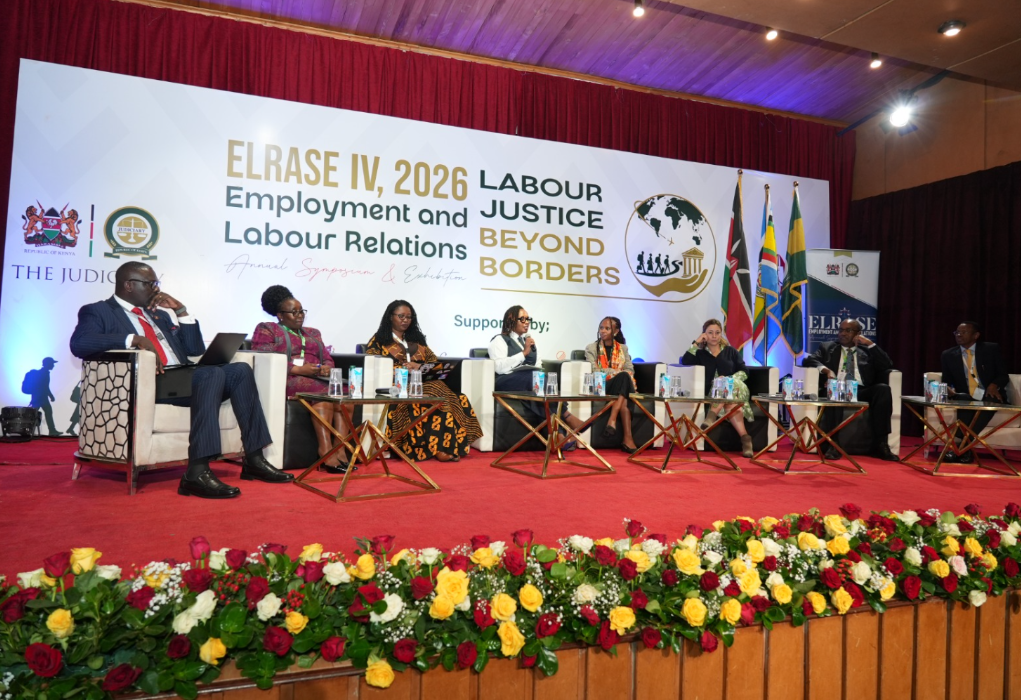
Prime Cabinet Secretary and Cabinet Secretary for Foreign and Diaspora Affairs, Musalia Mudavadi has called for stronger protection of Kenyan migrant workers through robust recruitment systems, effective bilateral agreements and dispute-resolution mechanisms as well as cross-border judicial cooperation, accessible alternative dispute resolution, and greater use of technology and innovation.
Speaking when he officially opened the fourth Employment and Labour Relations Annual Symposium and Exhibition (ELRASE IV, 2026) at Strathmore University in Nairobi held under the theme, “Labour Migration and Access to Justice: Strengthening Judicial Responses to Inclusive and Effective Labour Justice Systems,” the Prime Cabinet Secretary noted that access to justice should remain available to Kenyan workers irrespective of where they are employed.
He highlighted the growing importance of labour migration to Kenya’s economic development and foreign policy, noting that more than 540,000 Kenyans are employed abroad and diaspora remittances exceeded US$5 billion in 2025.
Mudavadi outlined Government efforts of promoting safe, regular and orderly labour migration through initiatives such as Kazi Majuu and bilateral labour agreements with destination countries, while addressing risks including fraudulent recruitment, trafficking, unsafe employment and exploitation.
He called for strengthened collaboration among the Judiciary, Government, employers, workers’ representatives, legal practitioners, development partners and other stakeholders to build a labour migration system that protects workers’ rights and dignity while supporting safe and productive international labour mobility.
On her part, Chief Justice Martha Koome, called for stronger, more inclusive and responsive labour justice systems, to protect workers in an increasingly mobile and interconnected global economy as well as for coordinated action among Government agencies, employers, trade unions, recruitment agencies, consular services, the legal profession, civil society, international partners and the Judiciary.
In a speech read on her behalf by Supreme Court Judge and Director General, Kenya Judiciary Academy (KJA) Justice Dr Smokin Wanjala, the CJ said labour migration was reshaping the world of work and required justice institutions to adapt to the realities of cross-border employment and challenged ELRASE IV to contribute to building “labour justice fit for an increasingly mobile world”— one where every legal right is matched by a realistic pathway to an effective remedy.

Justice Koome reiterated Judiciary’s commitment to responsive justice, that is anchored in the Social Transformation through Access to Justice (STAJ) blueprint, noting that it places people and their lived realities at the centre of justice delivery.
“Justice must travel with the worker,” the CJ said, emphasising that crossing an international border in search of employment should not mean crossing beyond the protection of the law.
CJ Koome noted that behind the statistics are individuals and families whose livelihoods depend on fair and dignified employment. She cautioned that migrant workers can face heightened vulnerabilities, including recruitment abuses, language and legal barriers, dependence on employers or recruitment agencies, and difficulties accessing complaints mechanisms and effective remedies across jurisdictions.
She identified procedural accessibility, timeliness, effective enforcement, vulnerability-sensitive adjudication and appropriate dispute-resolution mechanisms as key elements of a migrant-responsive labour justice system.
The Chief Justice underscored the importance of legitimate labour claims that are not defeated by the complexity of cross-border employment arrangements and called for appropriate case management and urgent relief in time-sensitive disputes, noting that delayed remedies can have particularly serious consequences for migrant workers and their families.
On enforcement, Justice Koome observed that effective justice requires mechanisms for cooperation on cross-border service, evidence gathering and enforcement within applicable legal frameworks.
She emphasised the importance of recognising the particular vulnerabilities of women migrant workers, domestic workers, young workers, persons with disabilities and victims or potential victims of trafficking, while safeguarding impartial adjudication and procedural fairness.
The Chief Justice encouraged the responsible use of Court-Annexed Mediation, conciliation and other appropriate dispute-resolution mechanisms, stressing that alternative dispute resolution must remain voluntary, fair and rights-respecting.
Speaking at the same forum, Employment and Labour Relations Court Principal Judge Monica Mbaru emphasised that labour migration is no longer simply about movement in search of employment, but is fundamentally connected to rights, dignity, economic opportunity, social protection and access to justice.
“While labour mobility creates opportunities for employment, skills development, innovation and economic growth, migrant workers can also face exploitation, unfair recruitment, wage violations, unsafe working conditions, discrimination, harassment, forced labour and other forms of abuse,” said Justice Mbaru.
She maintained that access to justice must extend beyond the mere existence of legal rights to ensure that workers can obtain timely, affordable, comprehensible, effective and enforceable remedies, regardless of their location, migration status or circumstances.
Saying that the responsibility of the Court is to ensure that judicial responses evolve alongside the changing world of work, including cross-border employment, digital work and increased labour mobility the Principal Judge underscored the importance of stronger institutional collaboration among the Judiciary, government agencies, employers and workers’ organisations, legal practitioners, civil society and international partners, while safeguarding judicial independence.
The Symposium brings together the Judiciary, Government, employers’ and workers’ organisations, development partners, academia, civil society and the legal profession to examine emerging challenges and opportunities in labour justice.
READ ALSO;
KNH Announces Death Of All Five Quintuplets Referred From Thika Level Five Hospital
