Kenya’s electoral agency has set campaign expenditure limits and financing requirements for candidates and political parties ahead of the 2027 General Election, including a KSh6.11 billion spending ceiling for presidential candidates and a KSh24.45 billion aggregate limit for political parties.
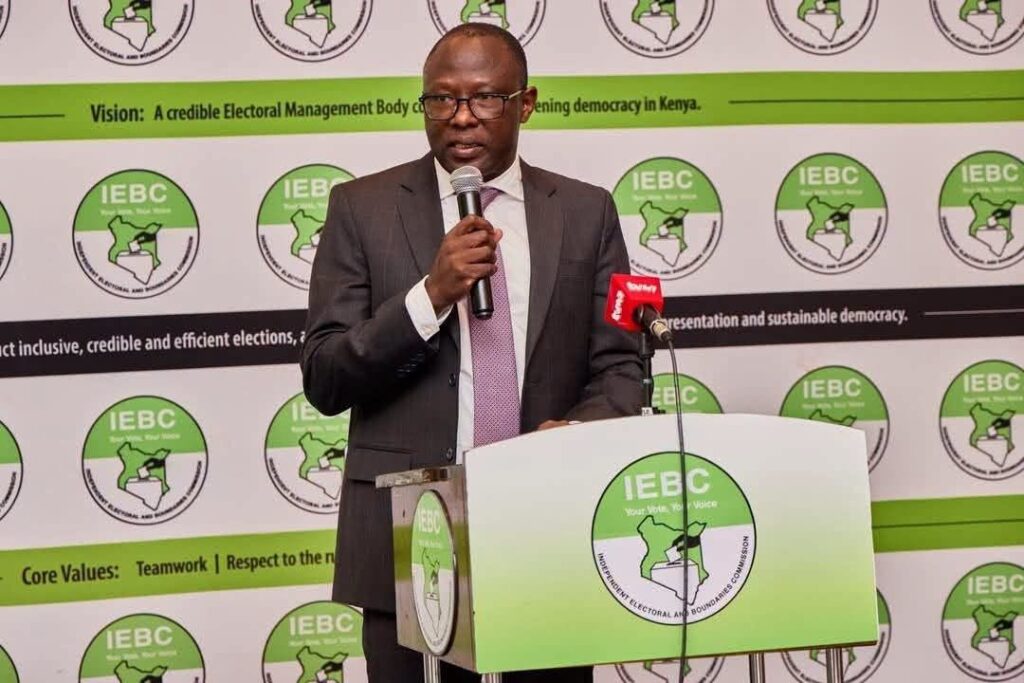
The Independent Electoral and Boundaries Commission (IEBC) has gazetted the new limits as part of measures intended to regulate campaign spending and promote a more level playing field among political contenders.
For political parties, transport accounts for the largest share of permitted expenditure, capped at KSh16.13 billion, equivalent to about 66% of the overall party limit.
Other major expenditure categories include advertising and media promotion at KSh2.52 billion, election agents at KSh2.08 billion, administration at KSh1.29 billion and publicity materials at KSh1.07 billion.
The regulations also allow individual contributors to provide up to 20% of the applicable contribution limit, potentially enabling large donors to finance a significant portion of a candidate’s or party’s campaign.
Banks will also be permitted to provide candidates and political parties with loans under ordinary commercial terms, with the loans treated as legitimate campaign contributions.
The IEBC said the spending and contribution limits are intended to prevent financial resources from becoming an overwhelming determinant of political participation, voter access and electoral competition.
Spending Limits Vary Across Counties
Campaign spending limits for devolved elections will vary considerably depending on geography. The IEBC has allocated 70% of the relevant costs based on population and 30% based on land area.
This formula creates significant disparities between densely populated urban constituencies and sparsely populated areas.
For example, Turbi Ward in Marsabit, which has about 20,383 residents spread across approximately 10,821 square kilometres, has a spending limit of KSh22.1 million.
By comparison, Embakasi Ward in Nairobi, with about 157,198 residents occupying just 22.5 square kilometres, has a ceiling of KSh10.68 million.
As a result, a candidate in Turbi can legally spend more than twice as much as one contesting in Embakasi despite representing a substantially smaller population.
Candidates contesting the positions of governor, senator and woman representative in Nairobi County have the highest county-level spending ceiling at KSh181.3 million. They are followed by candidates in Turkana, Marsabit and Wajir, while Lamu has the lowest county ceiling at KSh28.7 million.
Also Read: Radisson Hotels Targets Corporate Market with New Extended-Stay Offering
Among parliamentary contests, North Horr has the highest spending limit for MP candidates at KSh100.4 million, followed by Wajir South at KSh73 million and Turkana North at KSh59.7 million.
Wundanyi in Taita Taveta County has the lowest MP spending ceiling at KSh15.4 million.
The limits come as Kenyan campaigns continue to involve substantial spending on transport, cash handouts and branded campaign materials, including posters, T-shirts, shukas, boda boda reflectors and food items. Heavy campaign expenditure has frequently been linked to concerns over corruption and the misuse of public resources by elected officials seeking to recover campaign costs.
New Campaign Account and Audit Requirements
Under the new regulations, every candidate, political party, referendum committee and supporting organisation must maintain a dedicated campaign account with a registered deposit-taking institution.
Banks can provide campaign financing through loans issued on commercial terms. However, the arrangement could expose lenders to repayment risks if unsuccessful candidates struggle to raise funds or generate income after the election.
Campaign entities that spend more than KSh1 million will also be required to have their expenditure independently audited before submitting their reports to the IEBC. Given that even the lowest spending limits exceed this threshold, candidates mounting serious campaigns are likely to require external auditors.
Political fundraising will also face greater scrutiny. Contributions exceeding KSh20,000 must be receipted and linked to an identified donor.
Any anonymous or undisclosed contributions must be surrendered to the IEBC and transferred to the Consolidated Fund within 14 days.
IEBC Begins Election Procurement
As preparations for the 2027 elections gather pace, the IEBC has also commenced procurement for the Integrated Elections Management System, covering its supply, installation, testing, commissioning, support and maintenance, including associated hardware and accessories.
The tender is scheduled to close in September and requires bidders to provide KSh30 million in bid security.
A separate procurement process will cover ballot papers, tactile folders, the voter register and statutory election-results declaration forms, with bidders required to provide KSh40 million in bid security.