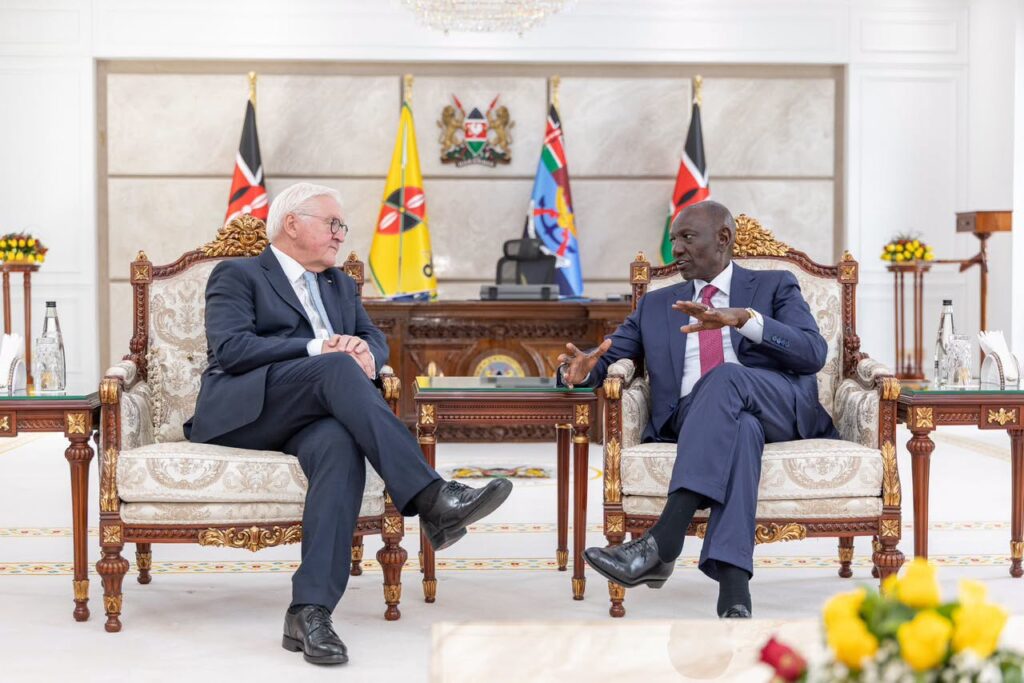
Kenya and Germany have agreed to expand their labour mobility partnership in a move aimed at creating more overseas employment opportunities for Kenyan professionals and skilled workers.
The agreement will focus on improving skills development, simplifying recruitment and visa processes, and expanding access to German language training and certification.
The announcement was made on Wednesday during German President Frank-Walter Steinmeier’s official visit to Kenya, where the two countries signed a series of agreements to strengthen cooperation in employment and skills development.
Steinmeier said Germany was keen to deepen the labour mobility agreement signed between the two countries in September 2024, particularly by equipping young people with relevant skills and linking them to employment opportunities.
Speaking during a joint media briefing, the German President emphasised the importance of creating structured, transparent and fair channels for Kenyans seeking employment in Germany.
He noted that the partnership would also strengthen cooperation in training skilled workers while providing young people with opportunities to access the German labour market.
President William Ruto said the discussions focused on transforming the longstanding diplomatic relationship between Nairobi and Berlin into practical economic and social benefits, including job creation and improved livelihoods.
Ruto revealed that the number of Kenyans working in Germany had increased from 7,170 in March 2024 to 9,500 in March 2026, representing a growth of 32.5 per cent.
Over the same period, the number of Kenyan trainees contributing to Germany’s social security system also rose from 820 to 1,260.
The President welcomed the progress made under the Comprehensive Migration and Mobility Partnership signed in September 2024, adding that both governments had agreed on measures to sustain the growth in employment opportunities.
Among the proposed interventions are simplifying visa and recruitment procedures, expanding language training programmes and speeding up the recognition of professional qualifications to make it easier for qualified Kenyans to secure jobs.
As part of the arrangements, Kenya signed a Memorandum of Understanding (MoU) with TELC, a German language examination and certification institution, to improve access to recognised German language qualifications for prospective workers.
The agreement is expected to strengthen the skills development component of the partnership by preparing Kenyan job seekers for the language requirements of employers in Germany.
Ruto also called for closer cooperation between Kenyan technical and vocational education and training (TVET) institutions and German industries to ensure that local training programmes match the skills demanded by the German economy.
The two governments are additionally exploring employment opportunities for Kenyan seafarers through structured training programmes, practical sea-time placements and partnerships with German shipping companies.
Their discussions also covered modernising port infrastructure, promoting sustainable shipping and attracting investment into maritime logistics, with Kenya seeking to leverage Germany’s expertise and the strategic importance of the ports of Mombasa and Lamu.
Also Read: Judiciary Faces KSh20.3 Billion Budget Shortfall Ahead of 2027 General Election
Beyond traditional labour migration, the two countries are looking to expand opportunities for Kenyans in the digital economy through cooperation in cross-border data transfers, business process outsourcing and exports of digital services.
Ruto said the conclusion of technical negotiations on a mutual data adequacy arrangement between Kenya and the European Union would support these ambitions by facilitating secure international data transfers, strengthening digital trade and improving the country’s competitiveness in the global digital services market.
The renewed labour partnership forms part of Kenya’s broader strategy to expand economic ties with Germany beyond conventional development assistance, placing greater emphasis on trade, investment, technology transfer and private-sector cooperation.
Currently, more than 120 German companies operate in Kenya, with the government seeking to attract additional investment into manufacturing, agro-processing, infrastructure, healthcare, renewable energy and digital technology.
Germany has also committed €52.5 million (approximately KSh7.8 billion) in development cooperation funding for the 2026–2028 period.
The financing will support programmes in renewable energy, agriculture, water and sanitation, infrastructure, as well as technical and vocational education and training.