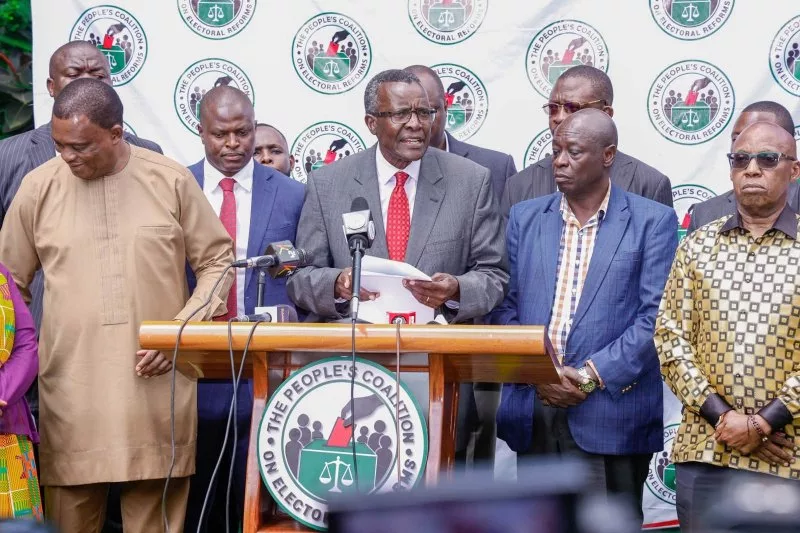
Former Deputy President Rigathi Gachagua and other opposition leaders have issued the Independent Electoral and Boundaries Commission (IEBC) with a December deadline to address their electoral reform demands, threatening to mobilise nationwide demonstrations if the commission fails to act.
The opposition, led by Democracy for the Citizens Party (DCP) leader Gachagua, accused the electoral agency of failing to address concerns surrounding the transparency, credibility and preparedness of the August 2027 General Election.
The leaders warned that they would take their grievances directly to the commission’s offices from January 2027 if their concerns remained unresolved.
Speaking on Wednesday, November 25, after a consultative meeting under the People’s Coalition on Electoral Reforms, Gachagua urged IEBC to engage opposition leaders before the end of December.
He warned that failure to respond to their demands would force them to mobilise Kenyans to stage demonstrations across the country.
Gachagua also dismissed President William Ruto’s recent warnings against demonstrations targeting the electoral commission, arguing that Kenyans had a constitutional right to demand accountability from IEBC.
He maintained that the President could not prevent citizens from expressing their concerns over the management of elections.
The meeting brought together several opposition figures, including United Green Movement (UGM) leader David Maraga, Martha Karua of the Liberal Party of Kenya (LPP), Jubilee Party’s Fred Matiang’i, Ndindi Nyoro of the People’s Liberation Party (PLP), Safina Party leader Jimmy Wanjigi and Democratic Party leader Justin Muturi.
The opposition leaders also declined to attend a meeting scheduled for Wednesday with IEBC, accusing the commission of failing to demonstrate its willingness to implement meaningful electoral reforms.
Gachagua argued that the proposed engagement, organised through the State Department for Interior, was intended to legitimise the commission’s actions rather than address genuine concerns raised by opposition parties.
Maraga similarly accused IEBC of being compromised, insisting that the opposition would not participate in consultations merely to endorse decisions already made by the commission.
The coalition described its proposed electoral changes as minimum and non-negotiable requirements for ensuring a free, fair, transparent and credible election in 2027.
Opposition’s Demands to IEBC
Among the key demands is an independent audit of the voters’ register to eliminate duplicate entries, remove deceased voters and ensure that all eligible Kenyans are properly registered.
The opposition has also called for mandatory electronic transmission and livestreaming of election results to strengthen transparency and minimise opportunities for electoral manipulation.
Additionally, the leaders want strict enforcement of constitutional provisions requiring presidential election results to be declared at polling stations and subsequently collated at constituency level.
They insist that results announced at polling stations should remain final, with the proposed decentralised transmission system allowing candidates, political parties, journalists and election observers to independently access election information.
Maraga proposed the introduction of a Decentralised Results Transmission System alongside a publicly accessible online portal featuring read-only media application programming interfaces (APIs).
The proposed platform would allow stakeholders to access electronically transmitted results, images of completed results forms and voter turnout information.
Also Read: Kenya, Germany Strengthen Labour Partnership as Kenyan Workers in Germany Reach 9,500
He also cited recent by-elections in Isiolo South, West Kabras, Muminji and Evurore, claiming that 27.3 per cent of polling stations failed to publicly display results forms, raising concerns about transparency and accountability.
On the recruitment of electoral officials, the opposition demanded that IEBC adopt an open, competitive and merit-based process, particularly when appointing Returning Officers and senior management.
Maraga questioned the transparency of the recruitment exercise, arguing that Returning Officers should be drawn from different parts of the country rather than being concentrated in one region.
The coalition further wants reforms to the commission’s election technology, proposing an open, modular and independently verifiable system with clear accountability safeguards.
The demand follows reported failures of Kenya Integrated Election Management System (KIEMS) kits in approximately 30 per cent of polling stations during recent by-elections.
The opposition argued that the technical challenges exposed weaknesses that must be addressed well before the 2027 elections to prevent disruptions during voting and results transmission.
The leaders maintained that implementing the proposed changes, alongside amendments to relevant electoral laws and regulations, was essential to restoring public confidence in the electoral process.
They warned that unless IEBC addresses their concerns, they would escalate their campaign through public demonstrations beginning January 2027.