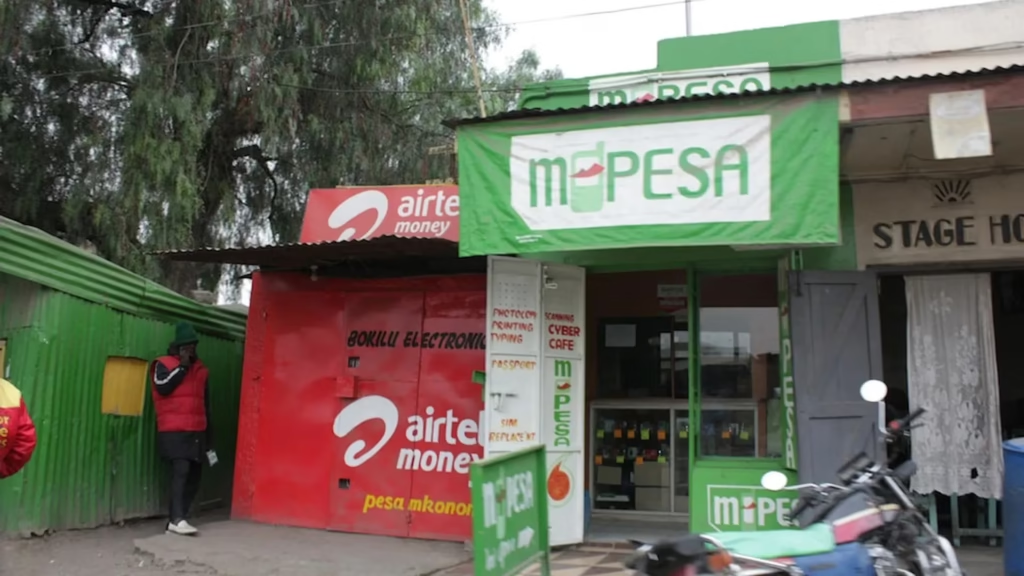
Kenya’s mobile money agent network has surpassed half a million outlets for the first time, even as the volume of cash transactions processed through those agents continues to shrink, according to new data from the Central Bank of Kenya.
Active mobile money agents stood at 507,383 in February 2026, marking a 28.5% increase from 394,853 recorded a year earlier. From the modest 307 agents operating when M-Pesa launched in March 2007, the network has grown into one of Africa’s largest financial distribution systems over the past seventeen years.
Despite that expansion, transaction activity moving through agents has weakened. In February 2026, agents processed KSh 633.35 billion, down nearly 20% from the KSh 790.8 billion recorded in February 2024, offering the clearest year-on-year comparison.
Agents remain central to Kenya’s cash-heavy economy, acting as the physical bridge between digital wallets and cash transactions in areas where traditional banking infrastructure remains thin. However, with mobile money penetration now reaching about 98% of the population and registered accounts climbing to 91.32 million, the push for access appears largely complete.
Across the whole of 2025, agents handled roughly KSh 8.14 trillion, compared to KSh 8.7 trillion in 2024, representing a decline of around KSh 560 billion or 6.4%. This came even as the number of active agents expanded significantly.
The shift is being driven partly by rising smartphone usage. Data from the Communications Authority of Kenya shows smartphones now account for 92.9% of connected devices, enabling more users to move funds directly between digital wallets without relying on physical agents.
Also Read: Treasury Turns to Natural Capital as Kenya Unveils Biodiversity Financing Strategy
At the same time, improved interoperability between platforms and the growth of digital banking channels are diverting more transactions away from agent outlets, squeezing commission-based earnings for operators.
The growth of Kenya’s mobile money network has unfolded in distinct phases. Between 2007 and 2015, expansion was rapid as M-Pesa evolved from a simple peer-to-peer transfer tool into a cornerstone of the informal economy. Growth later stabilised before the onset of the COVID-19 pandemic in 2020, when emergency fee waivers introduced by the Central Bank drove transaction volumes higher and attracted more agents into the market.
Following a period of stagnation between 2022 and early 2023, when the network hovered between 317,000 and 336,000 agents, growth accelerated sharply from mid-2024 onward. In just fourteen months, more than 126,000 new active agents were added, pushing the network to its current record level.
Safaricom continues to dominate the ecosystem, controlling around 89% of mobile money subscriptions through M-Pesa. Meanwhile, Airtel Kenya, through Airtel Money, operates an estimated 150,000 agents as it seeks to strengthen its foothold in the market.