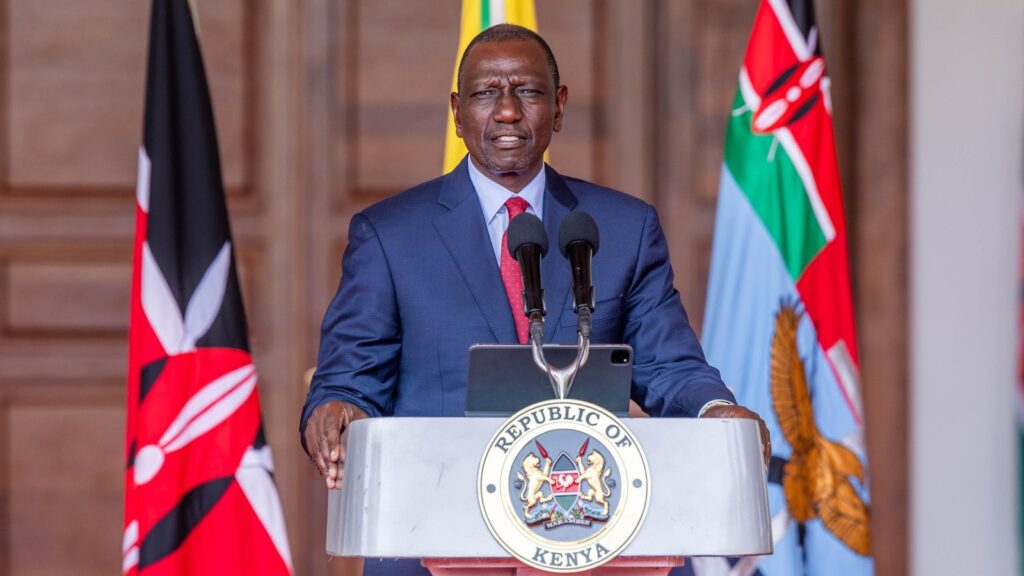
President William Ruto has intervened in a dispute between traders and the Kenya Revenue Authority (KRA) over the taxation, clearance and handling of consolidated cargo.
The intervention followed concerns raised by traders and other stakeholders in the consolidated cargo sector regarding the benchmark used by KRA to assess imported goods.
Following consultations between the government and industry representatives, the two sides agreed on measures aimed at improving compliance, transparency and accountability while easing the cost of importing goods.
Under the new agreement, KRA will lower the benchmark for general consolidated cargo from Ksh2.5 million to Ksh2 million.
However, the existing rates for ready-made garments, footwear and fabrics will remain unchanged. The recently negotiated rates applicable to air cargo will also continue to apply.
The government will further scrap the Advance Cargo Declaration requirement, a move intended to simplify the clearance process and facilitate legitimate trade.
KRA will also prepare and publish a list of goods that will be excluded from the general consolidated cargo framework. The list will take into account factors including the value and nature of goods, specific tax rates, excisable goods and other customs and revenue considerations.
The government said the list will give traders and cargo consolidators greater clarity on which goods can be consolidated and promote consistent application of the new framework.
As part of the reforms, all cargo consolidators will undergo fresh vetting and registration by KRA. They will also be required to provide details of the individual traders and importers whose goods they consolidate.
The deadline for completing the registration and vetting process, together with the submission of trader information, has been set for October 15, 2026.
The government will also support the establishment of designated de-consolidation centres in Nairobi and Mombasa. The facilities are expected to make it easier to separate consolidated shipments for individual traders while improving cargo handling and clearance and reducing unnecessary administrative and logistical expenses.
The announcement comes shortly after KRA issued clarification on how customs taxes are calculated for consolidated shipments, particularly those belonging to small-scale traders who combine their goods to lower transportation and clearance costs.
KRA said the consolidation system is designed to simplify customs procedures for small traders while safeguarding government revenue and ensuring compliance with the law.
Also Read: Media Owners Demand Probe Into Abduction Of Standard Editor Kiprotich
The authority explained that customs valuation is governed by Section 122 and the Fourth Schedule of the East African Community Customs Management Act, under which duty is generally assessed using the transaction value of imported goods.
KRA added that where importers provide the required commercial documents and meet legal and risk-management requirements, the transaction value forms the basis for customs valuation.
The tax authority said consolidation has become increasingly important to small-scale traders because it allows them to combine shipments, making transportation and customs clearance more efficient while reducing the administrative burden associated with numerous small consignments.
To facilitate clearance, KRA applies a minimum yield test to containers carrying commonly imported general goods. The approach provides a simplified clearance mechanism rather than requiring separate transaction documentation for every small trader whose goods are packed in the same container.
KRA said the minimum yield review was conducted in consultation with industry stakeholders. Following requests for more time to prepare for implementation, traders were granted a one-month grace period.
The revised minimum yield of Ksh3.2 million consequently took effect on August 21, 2026.