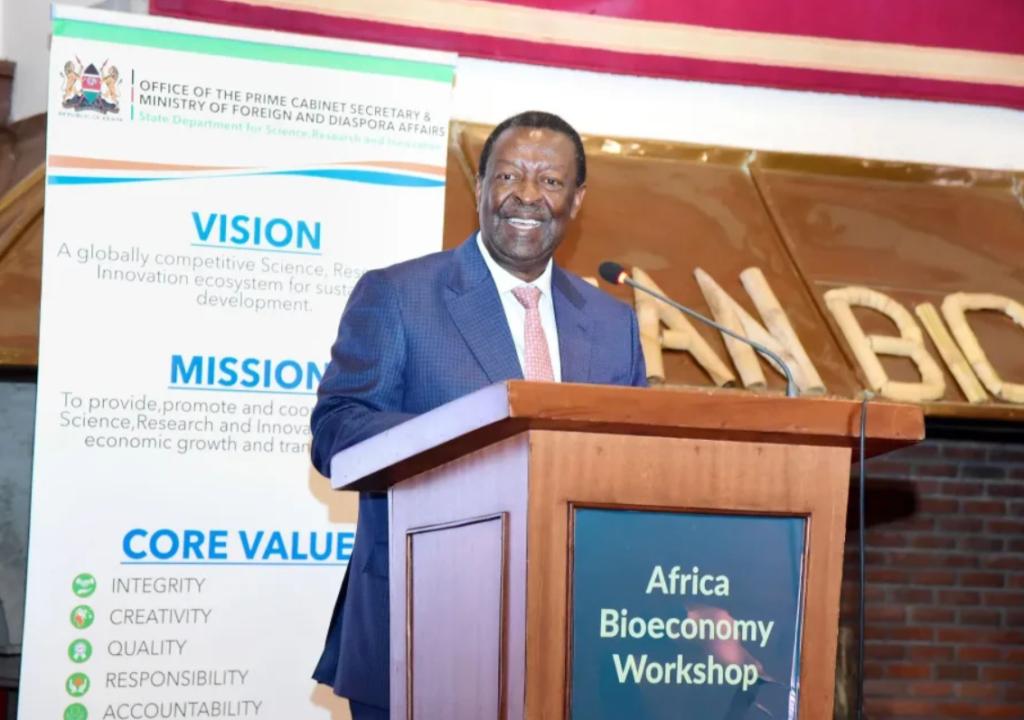
Kenya is committed to positioning itself as a leader in bioeconomy innovation in Africa, the Prime Cabinet Secretary and Cabinet Secretary for Foreign & Diaspora Affairs, Musalia Mudavadi, has said.
Speaking when he officiated the launch of the Kenya National Bioeconomy Strategy 2026–2036 at Windsor Golf Hotel & Country Club, Nairobi, Mudavadi said the Kenya National Bioeconomy Strategy 2026–2036 was expected to guide national and regional efforts over the next decade.
Mudavadi said the Bioeconomy Strategy was not simply scientific or environmental.
It is a whole-of-government economic and industrial strategy that fits squarely within our broader development ambitions under the Bottom-Up Economic Transformation Agenda, BETA.
“It provides a strategic response to some of the challenges confronting our economy, including exposure to external trade shocks, economic volatility, high unemployment and the growing effects of climate change. That is the economic proposition at the heart of this strategy,” said Mudavadi.
He noted that the Strategy is not just about economic growth; it is about building resilience, empowering our youth, and ensuring that Kenya’s prosperity is sustainable and inclusive.
He highlighted the role of research and innovation in delivering practical solutions for Kenya’s socio-economic transformation, and the importance of science and research in shaping Kenya’s future.
“The strategy provides a framework for harnessing bio-based solutions across agriculture, health, energy, and industry, and I emphasised the transformative potential of the bioeconomy in driving innovation, creating jobs, and safeguarding the environment,” said Mudavadi.
Mudavadi was joined by Prof. Shaukat Abdulrazak, Principal Secretary for the State Department for Science, Research and Innovation, who highlighted the role of research and innovation in delivering practical solutions for Kenya’s socio-economic transformation.
Also present were academia, civil society, and international partners including the Stockholm Environment Institute (SEI) and the International Centre of Insect Physiology and Ecology (ICIPE).
Mudavadi said every generation is defined, in part, by how it uses the resources, knowledge and opportunities placed before it.
For Kenya, the opportunity before us is immense.
“We have extraordinary biological diversity, a productive agricultural sector, a growing scientific and research community, a young population and an increasingly dynamic innovation ecosystem.
The question is no longer whether we have the resources to build a bioeconomy, but whether we have the vision and determination to turn those resources into greater prosperity for our people,”
said Mudavadi.
He said the strategy represented a commitment to move beyond simply being custodians and producers of biological resources, and a commitment to create value from what we have, to turn knowledge into enterprise, science into solutions, innovation into industries and our natural wealth into jobs and livelihoods.
“In that sense, the bioeconomy is not merely about biology. It is about the kind of economy we want to build and the kind of future we want to create.
The Strategy provides our country with a coordinated national framework for harnessing our biological resources, scientific knowledge, technology and innovation capabilities to create greater economic and societal value.”
He said the Kenyan young and growing population was an important asset and with the right investments in education, skills, research and innovation, we can build the workforce required to power new industries and compete in the global knowledge economy.
“We must therefore look beyond the production and export of primary.
Our ambition must be to increase domestic value addition, develop competitive bio-based products and industries,
commercialise innovations and support enterprises that are capable of competing successfully in regional and global markets,” said Dr. Mudavadi.
Dr. Mudavadi said BETA was fundamentally about transforming the structure of our economy, raising productivity, creating jobs, strengthening value chains and ensuring that economic growth
delivers tangible benefits to ordinary Kenyans.
“The bioeconomy gives us an important opportunity to take the biological resources that Kenya possesses in abundance and transform them into higher-value products, enterprises, industries and jobs, through science, research, technology and innovation,” said Mudavadi.
He said Kenya already possesses considerable scientific knowledge, biological resources and entrepreneurial capacity; what is required is the capital and financing architecture capable of taking viable ideas and enterprises from research and early development, through commercialisation and ultimately to scale.
“The Government has committed to progressively increasing investment in research and development towards 2 per cent of our Gross Domestic Product.
This reflects our recognition that research and innovation are not peripheral to development; they are fundamental drivers of productivity, competitiveness and long-term economic transformation.”
Public investment Dr. Mudavadi said, must increasingly catalyse private capital and strategic partnerships, and therefore the need to reduce barriers to innovation and enterprise development, create an environment in which new industries can flourish and encourage investment in competitive bio-based enterprises and value chains.
The discussions on mobilising significant investment into Kenya’s bioeconomy are therefore timely.
The development of a Bioeconomy Investment and Financing Roadmap will be an important mechanism for identifying viable investment opportunities, mobilising partnerships and connecting priority bioeconomy value chains and enterprises with appropriate sources of finance,” he said.
He said the launch of the Kenya National Bioeconomy Strategy 20262036 marks an important beginning, but a strategy, however well conceived, acquires meaning only when it is translated into action.
“Our task now is to turn ambition into investment, research into products, innovation into enterprises and our biological wealth into sustainable economic opportunity,” he said.
Mudavadi said there was a need to ensure that the young Kenyan who has an idea in a laboratory, on a farm, in a university or in an innovation hub can see a pathway from that idea to a viable enterprise.
“That is the promise of the bioeconomy. It is a promise that Kenya will not merely participate in the industries of the future, but will have the confidence and capacity to help build them.
It is also a reminder that our greatest natural advantage is not simply what lies beneath our soil or grows upon it.
It is what we can do with the knowledge, ingenuity and creativity of our people,” said Mudavadi.
READ ALSO;
