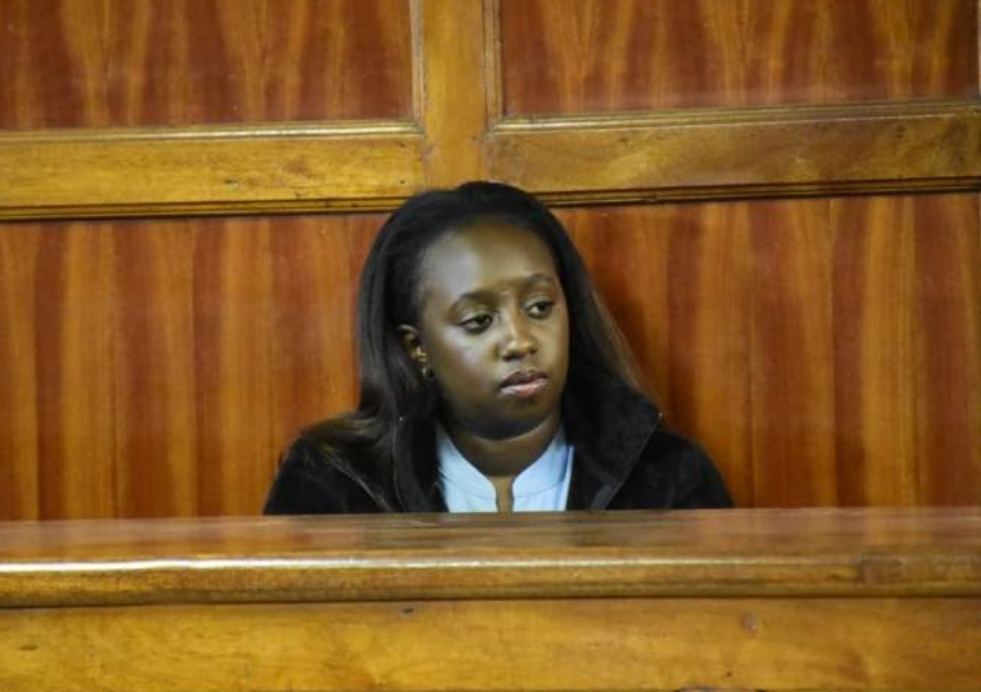
Rally driver Maxine Wahome was Tuesday acquitted of the murder of her late boyfriend, Asad Khan, after the High Court found that the prosecution had failed to present sufficient evidence linking her to his death.
Justice Lilian Mutende, in a ruling delivered on Tuesday, found that the prosecution had failed to establish a prima facie case against Wahome, meaning she would not be required to be placed on her defence.
Wahome had been charged with the murder of Khan, who died after sustaining serious injuries at Preston Apartments along Oloitoktok Road in Nairobi on December 12, 2022.
In reaching her decision, Justice Mutende analysed the evidence of 29 prosecution witnesses and found that none had conclusively established that Wahome inflicted the injuries that eventually led to Khan’s death.
The judge ruled that while the prosecution argued that Wahome and Khan were alone inside the apartment before he was found seriously injured, their presence together at the scene was not, on its own, sufficient to establish criminal responsibility.
The court held that the prosecution was required to prove that Khan’s death resulted from an unlawful act and that the act was committed by Wahome with the requisite criminal intent.
Justice Mutende found that the prosecution had failed to discharge that burden.
Evidence presented before the court showed that Khan survived for several days after the incident before he died from complications.
Medical experts attributed his death to sepsis arising from injuries that included head trauma, bruising and wounds described as defensive in nature.
Expert witnesses also told the court that some of the head injuries were consistent with a fall.
The court further considered evidence suggesting that interruptions in Khan’s medical care following his transfer between hospitals may have contributed to his eventual death.
The prosecution also relied on Wahome’s conduct following the incident, including allegations that she locked the apartment and prevented Khan’s relatives from accessing him.
Prosecutors further presented WhatsApp conversations exchanged between the two shortly before the incident.
However, Justice Mutende ruled that no witness testified to having seen Wahome assault Khan.
A neighbour who testified in the case only placed the two inside the apartment. He told the court that he heard Khan asking Wahome to leave before later hearing her respond that she was doing so.
Forensic evidence also failed to directly connect Wahome to the alleged assault. Blood samples recovered from the apartment were matched to Khan, while investigators did not recover blood-stained clothing or other forensic evidence linking Wahome to the injuries.
Investigators also recovered broken glass and a bottle from the scene. However, the court heard during cross-examination that the damage could have originated from inside the apartment.
The court further considered evidence that Wahome had retreated onto the apartment balcony during the incident and had herself sustained injuries.
Toxicology results presented during the trial also showed that Khan had alcohol, narcotics and prescription medication in his system at the time.
Justice Mutende further observed that even the investigating officer was unable to conclusively state that Wahome was responsible for the injuries that led to Khan’s death.
After evaluating the totality of the prosecution’s evidence, the
READ ALSO;
Relief As Court Lifts Shisha Ban, Terms Enforcement Unlawful, Unconstitutional
