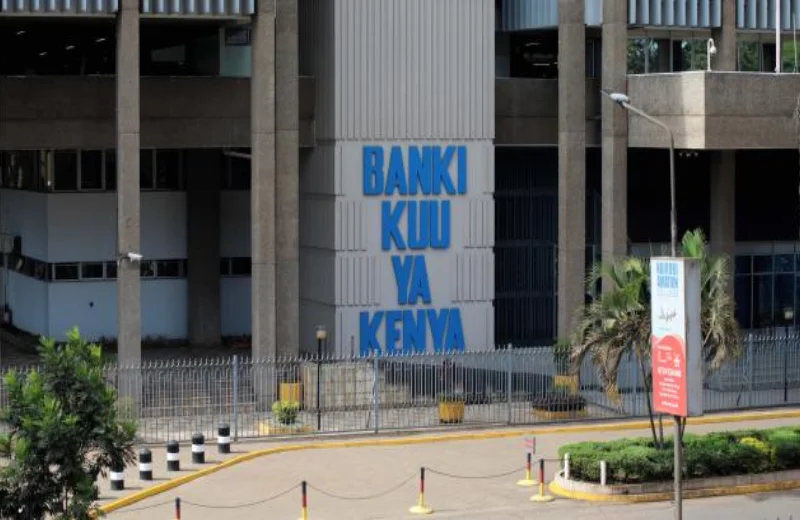
Commercial bank lending rates in Kenya continued to decline in June 2026, with the average lending rate easing to 14.38% from 14.49% in May, according to the latest data from the Central Bank of Kenya (CBK).
The figures highlight widening differences in lending strategies between large banks and smaller institutions, as liquidity levels and risk appetite increasingly influence the cost of credit across the sector.
Most tier-one local banks either maintained or slightly reduced their lending rates, signalling a measured approach to expanding credit, particularly to retail customers and small businesses. Meanwhile, smaller and niche lenders continued to charge some of the highest borrowing costs, with rates remaining above 17% due to higher perceived credit risks.
Foreign-owned banks and institutional lenders retained the lowest lending rates, supported by cheaper funding and strong corporate loan portfolios. Citibank N.A. Kenya recorded the market’s lowest average lending rate at 10.49%, down from 10.84% in May. Standard Chartered Bank Kenya and Stanbic Bank Kenya followed with average lending rates of 11.49%, while Habib Bank A.G. Zurich posted 12.58%.
Among Kenya’s major commercial banks, Absa Bank Kenya lowered its average lending rate to 13.48% from 13.55%, I&M Bank reduced its rate to 14.00% from 14.03%, while NCBA Bank Kenya recorded one of the biggest declines, dropping to 14.57% from 15.16%. KCB Bank Kenya trimmed its rate to 14.81%, Equity Bank Kenya eased to 14.82%, and Co-operative Bank of Kenya reduced its average lending rate to 15.08%.
Also Read: Mastercard Foundation Backs 12 Kenyan EdTech Startups Driving Inclusive Education
At the opposite end of the market, smaller lenders maintained significantly higher borrowing costs. Credit Bank PLC charged the highest average lending rate at 18.89%, up from 17.92% in May. It was followed by Access Bank (Kenya) PLC at 17.57%, Bank of Africa Kenya at 17.50%, SBM Bank Kenya at 17.38%, and Kingdom Bank at 17.02%.
The continued moderation in lending rates reflects the gradual pass-through of earlier cuts to the Central Bank Rate (CBR), despite the Monetary Policy Committee’s decision to leave the benchmark rate unchanged at 8.75% during its June meeting in a bid to keep inflation expectations anchored.
Deposit rates, however, remained broadly unchanged. The average rate slipped marginally to 6.84% in June from 6.86% in May.
Competition for customer deposits remained strongest among mid-sized lenders seeking stable retail funding. Credit Bank PLC offered the highest average deposit rate at 11.05%, followed closely by African Banking Corporation (ABC) at 10.93%. Development Bank of Kenya offered 9.91%, while Middle East Bank and Kingdom Bank posted 9.19% and 9.08%, respectively.
In contrast, multinational banks with ample deposit liquidity continued to offer the lowest returns to savers, led by Standard Chartered Bank Kenya at 3.00% and Citibank N.A. Kenya at 4.23%.