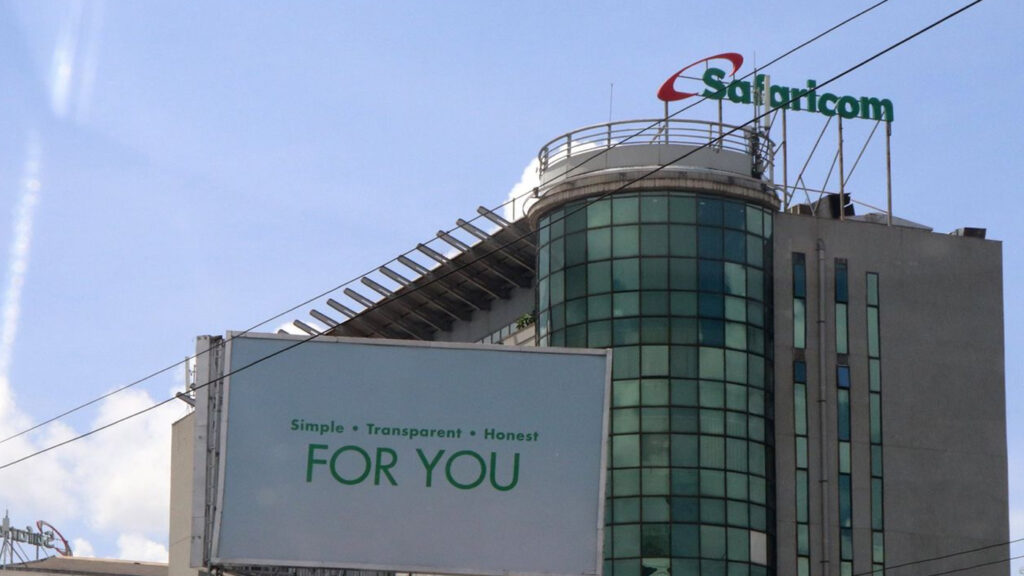
Safaricom has been ordered by the High Court to pay approximately KSh1.4 billion in damages, alongside continuing royalties tied to M-PESA revenues, after the court found the telecom giant liable for infringing a local innovator’s copyright in the development of a parental-control feature within M-PESA.
The dispute revolved around a concept known as “M-Teen Mobile Wallet,” created by Peter Nthei Muoki and his company, Beluga Ltd.
The proposed platform was designed as a youth-focused mobile wallet enabling parents to monitor spending, impose transaction limits, and manage accounts through USSD-based menus accessible on basic feature phones.
At the heart of the case was a central principle of copyright law: ideas themselves cannot be copyrighted, but the unique expression and structure of those ideas can receive legal protection.
Muoki told the court that he shared extensive concept documents with Safaricom executives in 2021. He later alleged that Safaricom launched a similar M-PESA child account management feature that mirrored the operational design and functionality of his proposal.
Safaricom rejected the allegations, maintaining that parent-controlled financial tools were already common within banking and software ecosystems. The company argued that it had independently developed the feature before Muoki’s presentation and cited a 2020 proposal from Huawei as evidence that work on the product predated any discussions with the plaintiff.
The defence largely hinged on the argument that the concept itself was generic and independently conceived.
Muoki, however, focused on demonstrating that the detailed implementation, including menu structures, command sequences, and system responses, had been replicated.
Why the Court Ruled Against Safaricom
In her judgment, Justice Josephine Mong’are agreed that the broad idea of a teen-focused digital wallet was not original in itself.
However, the court found that Muoki’s documentation went beyond a simple concept by laying out a detailed operational framework for how the platform would function. That specific structure, the court ruled, qualified for copyright protection as a literary work.
Justice Mong’are stated that while similar products could exist around the same concept, the evidence suggested Safaricom developed its product after gaining access to both the idea and its detailed expression from the plaintiffs.
The court determined that Safaricom had access to the material through meetings involving company executives and concluded that the telecom firm failed to produce convincing proof that the feature had been independently created.
The ruling highlighted inconsistencies in Safaricom’s development timeline, missing technical records, and gaps in supporting documentation. The court further held that the similarities between the two systems were substantial enough to support a finding of copying.
Safaricom’s reliance on Huawei’s earlier proposal did little to resolve the court’s concerns.
Although Huawei produced a proposal dated September 2020, the judge noted there was no sufficient evidence showing a finalised product design or formal implementation instructions at that stage.
The timeline also proved significant in the decision. Muoki’s presentations reportedly took place between March and June 2021, while Safaricom’s product launched in November 2022.
According to the court, the sequence of events, coupled with the similarities between the products, pointed more convincingly toward copying rather than coincidence.
Damages and Ongoing Royalties
Despite finding infringement, the court declined to issue an injunction that would have forced Safaricom to shut down the feature, citing its extensive use and the potential disruption such an order would cause to millions of M-PESA customers.
Instead, the court awarded damages based on a percentage of M-PESA revenue.
The ruling set compensation at 1% of M-PESA revenue for the 2024 financial year, amounting to approximately KSh1.4 billion.
Safaricom was also ordered to continue paying royalties equivalent to 0.5% of M-PESA revenue for as long as the disputed feature, or any substantially similar functionality, remains operational.
Also Read: Safaricom Jumps 8.4% After Historic Earnings as Banking Stocks Drag Market Lower
In assessing damages, the court dismissed Safaricom’s argument that the feature did not directly generate revenue.
The judge found that even if the service itself is not separately billed, it still contributes to wider M-PESA usage, which ultimately drives transaction volumes, customer engagement, and overall revenue growth.
In a strongly worded conclusion, Justice Mong’are described the case as a warning to both innovators and large corporations, observing that valuable ideas do not solely originate within corporate boardrooms and that independent innovators can prevail when supported by sufficient evidence.